Monday, February 15, 2010

The Snow of 2010

New Yorkers got pounded with snow in January and February. Two of the bigger storms hit on January 2 and February 10. Generally I'm not a big fan of snow, but this year it was especially pretty because there was very little wind. The snow could cling to the branches of the trees, and my everyday world took on a bit of magic.

Here are the best of my winter snow pictures. Most are from Stuyvesant Town, the Manhattan apartment complex where I live. Others are from Times Square where I work.


The Stuyvesant Town Christmas tree looked quite elegant in the snow!


A completely different type of evergreen, I can't decide if this tree looks ballerina-like and comical, or menacing and ghoulish.


Back view of the playground outside the building where I live.
It's closed today, kids.


Front view of the same playground. Note the time on the clock over the center structure. It's 10:30 AM and I'm clearly late for work.


A cluster of snow-lined trees.


The red bark on this tree contrasts nicely with the snow.


The cab adds a splash of color.


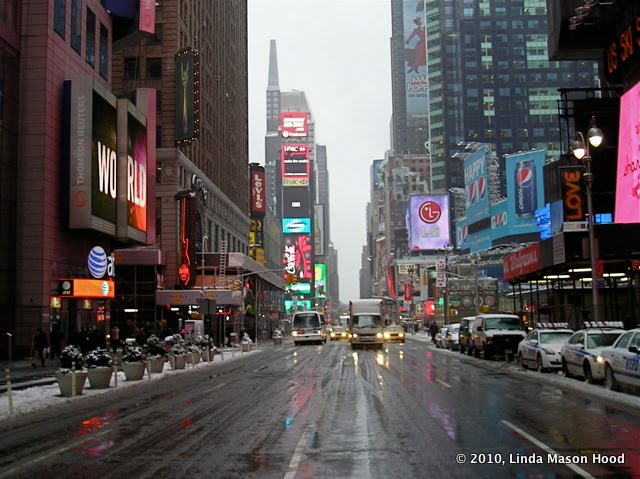
Times Square, looking north on Seventh Avenue. Here, the snow melts quickly from the traffic and the heat of the subway under the street. My camera wasn't able to show how hard it was snowing, but that's why the cars and buses all have their headlights on at 11:20 AM when this picture was taken.


From the 15th floor of the office building where I work, we can see the snow gracing Madame Toussaud's hand atop her wax museum located on 42nd Street.


6:43 PM and it's still snowing in Times Square.
Yes, friends, I went to work in a blizzard. Sad...


© 2010, Linda Mason Hood
Truffles, Turtles & Tunes Copyright Statement

Thursday, February 11, 2010

My Flute Journey Continues


Since the December 25th arrival of my Peter Noy flute, I've been happily adapting to it. Both my embouchure and my hands are undergoing many changes. As I practice every day, I see rapid progress. If nothing else, switching from flute to flute over the past few years has taught me how to quickly adjust to a new instrument, a skill I hope I will no longer need!

Playing a different flute involves work in several areas.
  • EMBOUCHURE: One must learn how best to direct air across the flute's blow hole so that a variety of timbres can be produced and proper pitch can be maintained. This area of work involves strengthening and retraining the muscles of the face and lips.
  • HANDS: One must train the fingers to cover the holes. The fourth finger (the ring finger) on each hand is usually the most problematic, as it is the weakest and hardest to control. The finger span of my hands is average, but even so, I need to develop more strength to consistently cover the holes when playing at top speeds.
To strengthen my embouchure and hands, I am doing two types of work:
  • TECHNICAL: Long tones develop embouchure strength and accurate pitch. Finger exercises allow me to work on various patterns that will develop my coordination while I gain strength in the wider hand stretch required of my right hand. I'm working on my left hand position, rolling the headjoint inwards to give more freedom to my left wrist and to better balance the flute against my index finger. I'm also paying attention to throat articulation and the position of my right thumb.
  • TUNES: To keep from being bored out of my mind, I declared January to be Polka Month. Polkas are easy to learn and fun to play in sessions. Conal O'Grada, my teacher at Willie Clancy Week last summer, taught us some polkas so I reviewed those. I'm also learning a few from Fliuit, a flute instructional tutor by June McCormack as well as from The Irish Flute Player's Handbook by flutemaker Hammy Hamilton. I've worked on 15 polkas in January and I'm having a pretty good time, so maybe I'll keep going for another few weeks.
Thinking about how I came to develop these transitioning skills, I started to recall my journey through Irish traditional music. Being an inveterate list maker, my recollections took the form of a timeline which begins before I started blogging. Once the blog was established, I had a place to reflect on my frustrations and record my progress. Note the links and corresponding labels used for grouping similar topics.

The collage below makes the point in a more concise way, showing the variety of instruments I've played since 2003.


Top left - borrowed
Casey Burns keyless boxwood flute
Top middle - my Cillian Ó Briain tin whistle (2004 photo, lesson with Mary Bergin)
Top right - Peter Noy head joint, on loan, for my silver flute
Bottom left - borrowed Terry McGee keyless African blackwood flute
Bottom middle - my Casey Burns mopane folk flute
Bottom right - my Wm. S. Haynes handmade solid silver flute
Center - my Peter Noy 6-keyed boxwood flute


Yes, the years since that momentous visit to Ireland in 2003 have been full of growth and adventure. During that time I've become acculturated in the world of traditional Irish music and have learned many tunes. I've experimented with Irish piano accompaniment and have discovered I can sing a bit when I'm of a mind to do so. I've even tried set dancing. Flute is my primary interest though, and now that I have a good instrument I'm ready to do some serious work on my playing abilities. If only there were more hours in the day!


© 2010, Linda Mason HoodTruffles, Turtles & Tunes Copyright Statement

Sunday, January 24, 2010

Music in the Mountains and on the Subway

On January 16, 2010, the Washington Square Harp and Shamrock Orchestra performed in Queens at the New York Irish Center. Our pianist, Brendan Dolan, was giving a lecture called Music in the Mountains. This fascinating talk focused on a region of the Catskills where Irish Americans have vacationed for generations. Brendan researched this topic for his master's degree in Irish and Irish-American Studies at New York University. The event was well attended and the food was great. Click here to see the New York Irish Center's report which includes a few pictures.

I traveled to our gig by subway. Nothing unusual about that. I was plugged into my iPod listening to a recent CD by Green Fields of America. The WSHSO plays many of the tunes on particular CD, so I was tappin' my foot and gettin' in the groove for the evening's performance when a young woman named Lisa interrupted me. Lisa explained that she was interviewing people for her blog called What Are They Listening To On The Subway. We chatted, she made careful note of my music and snapped my picture. In just a few minutes my routine subway ride was turned into a real New York adventure. Click here to see the post. Thanks, Lisa, and good luck with your project!

© 2010, Linda Mason Hood
Truffles, Turtles & Tunes Copyright Statement

Saturday, January 16, 2010

My New Flute!

It arrived on Christmas day. A post office deliveryman rang my doorbell at 10:56 AM and handed me the package I've been waiting for since May 8, 2008. My new flute is finally here!

My Merry Christmas!
A new coat (with tags still dangling from the sleeve), a new watch, and a flute!

The flute Peter Noy made for me is a six-keyed boxwood flute. The head joint is unlined and unthinned, with a Cooper cut embouchure which includes a blow edge insert made of horn. The rings which reinforce all the joints are made of horn as well. Modeled after the Rudall & Rose 19th century flutes, it has rather large Nicholson-style finger holes. The middle joint is divided. With six keys, it is a fully chromatic instrument. The traditional Irish repertoire doesn't use the flute's third octave, but this flute does in fact have a viable and pleasant sounding third octave.

The flute, cleaning rod, and humidifier rest in modified art supply case.

The head crown of my flute was made by Catherine Crowe of Toronto, an enamel artist and traditional Irish singer I met in the Catskills. Unbeknownst to me, Peter and Catherine have been friends for years, which is how Peter came to have the enamel crown Catherine made. Reading my blog posts, Peter recently discovered that I knew Catherine as well and suggested I might like her crown on my flute.

Catherine's art uses patterns and objects that draw their significance from the folklore of ancient Celtic, Scythian and Etruscan cultures. The pattern she used for the flute's crown is the Celtic triple spiral. According to Catherine, The triple spiral is one of the oldest Celtic designs. It was in use from the 7th century BC right up to the present. This particular one is based on an enamelled escutcheon from around the 7th century AD. (Click here for more information)


Interestingly, Catherine's triple spiral is very similar to Peter's logo which incorporates a stylized representation of the three-pronged trillium, the emblem and official flower of Ontario. The trillium holds special significance for Peter because he grew up in Ontario and lived in Toronto for many years.


Like the flute makers of old, Peter engraves his logo on each section of the flute. The main stamp, to the right of the right-most ring in the picture below, has the letters NOY arranged in a semi-circle under the trillium shape. From this photo's prespective the stamp is on its side, with the N at the bottom. The main stamp is located on the flute's third joint. The stamp Peter uses on all the other joints is simply a very tiny trillium, as seen on either side of the left-most ring. You can see these a little better, especially the one on the lighter piece of boxwood. Double-click on the picture below to enlarge it.


At first I thought Catherine's design was a fancier form of Peter's logo. However, in email conversation with both Catherine and Peter, I realized that each design was distinct, with its own meaning and story. It's a rather an uncanny coincidence that the two are so similar!

In the end, I came to appreciate the synchronicity of my flute's two symbols. It reminds me of the ribbons in a Celtic knot, twisting through both personal and historical circumstances. All of the Canadian provinces, including Ontario, took in many immigrants from Ireland, particularly during 1800's as a result of the Great Famine. As a result, Ontario has a rich and lively Irish community, with an Irish Canadian population of approximately two million people according to the 2006 census. Living in Ontario and participating in the Irish community, both Catherine and Peter would have been exposed to many Celtic patterns over the years. Likewise, I'm sure they both would have seen the trillium represented in many forms for various reasons. In an email exchange with Peter about the relationship of his trillium logo to the triple spiral, he concluded it was what Joyce called " the ineluctable modality of the visible." (and if you need help with that statement, as I did, click here)

In closing, here are a few more pictures. Actually, taking good flute pictures is quite difficult. One needs a much better camera than mine and proper lighting to prevent the the flash or the sun from reflecting off the finish and distorting the rich hues of the wood. Nevertheless, I hope these photos will give you some idea of the marvelous workmanship that goes into a Peter Noy flute. I'm just thrilled with it. Bet you never would have guessed!!


© 2010, Linda Mason Hood
Truffles, Turtles & Tunes Copyright Statement

Friday, January 01, 2010

Testing the Times Square Ball

This year I had to work on December 30, 2009. I was happy about going to work on this particular day because being in the office meant I would be able to watch the test of the New Year's Eve ball drop. From the 30th floor of the Times Square office building where I work, I had a great view of an event which very few people get to see. Naturally I took a few pictures.

Here, the unlit ball is resting at the bottom of the pole behind the Toshiba sign.


Here's a closer view of the ball, showing one of it's many colored patterns.


The test of the ball went well, as you can see below. Using iMovie I was able to splice together several short video clips taken with my digital camera. The background music is Ramsey Lewis playing What Are You Doing New Year's Eve. Have a look!

(Tip: the video quality is better if you don't go to the full screen view. It's a rather old camera.)


Two years ago I wrote about the 100th Times Square Ball-Drop. Last year a new ball was installed. The Times Square Alliance website describes last year's ball as follows: "The new Times Square New Year’s Eve Ball is a 12 foot geodesic sphere, double the size of previous Balls, and weighs 11,875 pounds. Covered in 2,668 Waterford Crystals and powered by 32,256 Philips Luxeon Rebel LEDS, the new Ball is capable of creating a palette of more than 16 million vibrant colors and billions of patterns producing a spectacular kaleidoscope effect atop One Times Square."

For the 2009 ball drop, the new 2008 ball was modified to include 288 new Waterford crystal panels. The clear glass panels have a swirling Celtic design with a colored icon in the center. The YouTube video below offers more details and shows closeups of the panels.


Twenty-Ten... 20-10... It has rather a nice ring, don't you think? It's a number that is fun to say aloud. (Remember how pleased you were when you realized you could count backwards?!) We can't turn back the clock. I'm not even sure we would want to. (Ok, I lied - maybe we could turn it back just a little bit!!) All kidding aside, though, hopefully 2010 will be an upbeat year in which we take more joy from the basic, simple pleasures of life and focus on what's really important.

Happy New Year!


© 2010, Linda Mason Hood
Truffles, Turtles & Tunes Copyright Statement

Tuesday, December 22, 2009

Sing We All Noel

This Christmas season has been full of Irish music activities. For me, the Christmas season began in early December when I attended a Cherish The Ladies concert, a rousing, energetic performance of many of the songs and tunes on their new Christmas CD, A Star in the East. As a member of the Washington Square Harp and Shamrock Orchestra I was part of Mick Moloney's Irish Christmas concert series at the Irish Arts Center. The WSHSO also played in the Airneal na Nollag, an annual holiday celebration at New York University's Glucksman Ireland House. Additionally, we provided music for the Christmas party of the Irish American Bar Association of New York. I attended a session at the Landmark Tavern when Jimmy Crowley was in town. I've been to several sessions at Lillie's this month, and last night I went to the massive Christmas session at Dempsey's. All the bars are beautifully decorated for Christmas, making the sessions seem very festive.

Christmas music is everywhere. My husband has many CDs containing both secular and sacred Christmas music. We listen to them at home and in the car, and I have loaded my favorites onto my iPod. On the piano I practiced both Advent and Christmas hymns in preparation for accompanying two worship services this month at Manhattan Mennonite Fellowship. On the silver concert flute I'm working on Danse des Mirlitons from Tchaikovsky's Nutcracker Ballet, to be played at MMF on January 3, 2010. On the wooden Irish flute I re-learned the Christmas Eve reel, a standard of the season. During the Irish Arts Center gig I enjoyed the repeated performances of Mary's Boy Child as sung by Donie Carroll, Louise Sullivan's poignant rendition of Jackson Browne's The Rebel Jesus, and Mick Moloney's driving version of Down Among the Bushes of Jerusalem. Liz Hanley's singing of Christmas in the Trenches brought home the painful reminder that war (still) prevails instead of "Peace on Earth" about which the angels sang. Liz also sang The Cherry Tree carol which I sang at MMF last year. My own new Christmas song this year is an Appalachian song called In the Valley. I learned it from a Little Windows Christmas CD called Snowman's Waltz. Hopefully I'll get to sing it somewhere before the season is over.

Music is an integral part of the Christmas holiday season. It speaks to us, moves us, in a way that nothing else can. Christmas music washes over us everywhere we go. It permeates the air. It comforts us and helps us rejoice. I think perhaps it's one way that God comes to earth and makes His presence felt. That's my experience anyway. Perhaps it's yours as well. So...

May your Christmas be merry, and May there be music!
Sing We All Noel


© 2009, Linda Mason Hood
Truffles, Turtles & Tunes Copyright Statement

Wednesday, October 07, 2009

Remembering Frank McCourt


Left to right: Liz Kennedy, Jimmy Crowley, me, Mick Moloney, Daniel Neely,
Malachy McCourt, David Amram, Tony Horswill, Kate Bowerman.

Last night I participated in a very special event called Remembering Frank McCourt, a memorial gathering at Symphony Space for the Pulitzer Prize winning author of Angela's Ashes who died on July 19, 2009. Attending this event caused me to reflect on the many ways I was connected to Frank McCourt.

Saturday, September 05, 2009

Migration Assistant Misery

Misery is surely a fitting description for my experience with Apple's Migration Assistant utility. Hoping to save someone else from a similar ordeal, I'm going to share my experience.

I recently replaced my son's 4-year-old Powerbook G4 1.5 with the new MacBook Pro Core 2 Duo 2.26. In many respects this new MacBook was an exciting improvement over the poor Powerbook, with its missing tab key and dented case.

Powerbook on the left; MacBook Pro on the right.

The Migration Assistant utility seemed to be the best way to move my son's 54 gigabytes of data. This utility would transfer not only the user account but also all the data and settings associated with it. In the end, Migration Assistant did finally deliver as promised, but not without inflicting significant pain.

The FIRST attempt at migration failed because I selected Wireless Network as the migration method. It seemed the easiest, but after 30 minutes of "preparing to migrate..." Migration Assistant finally estimated that the migration would take about 15 hours. Who has that much patience, right? So I canceled that migration attempt.

The SECOND attempt started badly because it seemed to think data for the user had already been transferred from the previous aborted attempt. Therefore, I set up another user account, very similar to the first one. Having now located my ethernet cable, I selected Ethernet as the migration method. That reduced the estimated time to 3 hours. Much better!

Near the end of the process the screen display said "less than one minute remaining" -- for 20 minutes or so. With mounting concern, I turned to the internet for help and read that one should not assume Migration Assistant was in trouble unless it ran for more that 12 hours. By this time it was midnight, so I just went to bed and left it to run its course.

By 7 AM the screen displayed a message "...finished successfully." However, clicking on the Finish button produced a message that there were errors -- errors which would remain a mystery because there was no explanation or error log. Left completely to my own devices, I started poking around in the Finder to see what Migration Assistant had done, or not done, and I found indications that all was not well.

Clearly in need of help, I called Apple Support. After 15 minutes of troubleshooting I was transferred to a technical specialist named Sean. Patiently, he explained that establishing multiple user accounts with similar names had caused unnecessary copying of data. His bigger concern was that system security programs might encounter future hard-to-diagnose issues stemming from those user accounts with extremely similar names. (User accounts form the very basis for all system security.) He advised me to erase the hard drive -- Gulp! -- and restore the system to the way it was when I took it out of the box.

Entering a new realm of Mac maintenance, then, I erased the hard drive with one click, and reinstalled the operating system with those disks that come with every new computer. You know, the ones you hope you never have to use... But wow! What an improvement over Microsoft! There were no confusing questions to answer, and the whole operation took only 30 minutes.

Off and running now, I began my THIRD attempt at Migration Assistant. Again I selected Ethernet as the migration method. After an hour of "Searching for documents to migrate to the new computer..." I called Apple Support again. Sean was not available, but Jay explained why this third attempt would never complete (I'll spare you that convoluted story) and advised the FireWire migration method.

Since I needed to go out and buy a FireWire cable, Jay called back in an hour -- yes, a support person actually called me back!!! -- and thus began my FOURTH attempt at Migration Assistant. I was a little nervous about going into FireWire target disk mode, a process used by the FireWire method. However, working with FireWire target disk mode proved to be far less scary than booting up a Windows PC in SAFE mode. You just hold down the T key while you boot up, and release it when the FireWire symbol appears on the screen. At that point the whole computer is just an external hard drive. But returning to the saga, the estimated migration time using the FireWire method dropped to 1 hour 30 minutes! Jay said he'd call back a second time to make sure it finished successfully. At this point I actually began to believe I might complete this process in my lifetime!

Migration Assistant completed about 15 minutes early so I had a chance to verify the results. All the data was transferred and the user account was properly named. The machine name that was transferred included the word Powerbook, and so I replaced that with the words MacBook Pro. The dock contained some question marks representing applications I had chosen not to transfer, so I got rid of those empty dock items. I installed the iLife applications which were erased when I did the operating system re-install. I also installed the 2008 version of Microsoft Office for Mac. My son would need to download fresh copies of a few internet applications, but other than that, everything looked good. When Jay called, he concurred that this fourth attempt had succeeded.
Finally -- 21 hours after beginning the first migration attempt -- I able to hand over the MacBook Pro to my son.

Lessons Learned: If you're using Migration Assistant to transfer data from an older Mac to a new one,

1) GIVE A FICTITIOUS NAME WHEN YOU BOOT UP THE COMPUTER FOR THE FIRST TIME. (Actually, this tip comes word-for-word from Jay in the Apple Tech Support group.) Doing this will establish a user account on your new system that is completely different from your old system. Migration Assistant will then have no conflicts whatsoever and can copy your old user account and everything associated with it. When Migration Assistant has completed, just delete the fictitious user account.

2) USE A FIREWIRE CABLE. (This tip comes from my own experience.) Forget about doing it any other way. Anyone who can afford an Apple computer can afford a $20 FireWire cable. Caution: You will need to know the speed of the FireWire port on each machine. You can look that up online, or just call Apple Support. Based on the model number I gave him, Jay informed me that the Powerbook had a 400 Mbps (megabytes per second) FireWire port, whereas the MacBook Pro had an 800 Mbps port. He instructed me to by a "400 to 800" FireWire cable.

Alternatives: (if you have no"geeky" inclinations whatsoever)

a) Make an appointment at the Genius Bar in an Apple Store, and an Apple Genius (in-store tech support person) will do the whole migration for you. You will have to take your old Mac and your new Mac into the store and maybe leave them both there for a day or so. But hey, if your at-home migration goes as badly as mine, you wouldn't have had the use of your computer anyway! This service is free, so if you live near an Apple Store, why not leave data migration to the experts?

b) Call Apple Support before you turn on the new machine for the first time. If I were you, I'd ask the agent who picks up the call to transfer you to Technical Support for help transferring data from one computer to another. Go right to second level support, as these guys know a little more and explain things a little better. Even if you didn't buy the Apple Care extended warranty, this call is covered under your purchase warranty.

Do I wish I had moved the data manually from a backup? No. When it works properly, Migration Assistant is amazing. My son felt instantly "at home" on the new MacBook Pro. There were no preferences to adjust; everything looked and felt the same. I just don't think all the aggravation I went through was necessary. Apple usually does a pretty decent job of making applications user friendly, so I never expected to encounter such poor instructions. If Apple feels compelled to offer Wireless and Ethernet as migration options, they owe it to the user to explain the implications of each choice. That alone would have spared me 21 hours of anxiety and uncertainty. So yea, it was a real pain and I regret that. In the end, though, I learned a few things to share here with anyone -- even the folks at Apple -- who might stumble upon this post. Please feel free to leave a comment if you found this helpful.


© 2009, Linda Mason Hood
Truffles, Turtles & Tunes Copyright Statement