Showing posts with label family. Show all posts

Friday, November 18, 2011

Fatherly Connections

Ralph Mason (left) and Mike Rafferty (right)

Ralph Mason and Mike Rafferty were two very different men.  Ralph was my father, Mike was my flute teacher.  I began lessons with Mike in 2004, six years after my father died.  Over time, I found myself making comparisons between them.  A few similarities existed despite the fact that other things about them seemed to be reversed, just like their initials.

Friday, February 25, 2011

Three Days in the Olympic Peninsula

(Part I of a three-part series on my 2010 vacation in the Pacific Northwest)

I hate winter. One of my most effective coping devices involves either planning future vacations or reliving vacations I've taken in the past. In the spirit of getting through the winter, then, here's the first of a three-part series devoted to my excursion to the Pacific Northwest in September of 2010, when my husband and I toured through the Olympic Peninsula, Seattle, southern British Columbia, and the Mt. Baker wilderness.

Part I will confine itself to our three days in the Olympic Peninsula. Our route is depicted below. The various locations I describe will match the letters on the map.


View Larger Map

Saturday, January 01, 2011

In memory of Kitcat...


As I admired our Christmas tree this year, I missed Kitcat. This was our second Christmas without him, without any cat at all. Although there are certain advantages -- no tinsel eaten and no ornaments broken -- I missed having a cat under the tree.

Sunday, December 05, 2010

Governors Island 10K Race

The Hood family was up early on Sunday, October 3.  The occasion was our son Michael's first 10 kilometer race, held on Governors Island. We took the 7:10 AM ferry, but the race didn't start until 8:30 AM so we had plenty of time to enjoy the views. The sun hadn't been up long, as you can see from the hint of a sunrise in the pictures below. What you can't see are the strong gusts of wind reminding us that fall had arrived.

The Manhattan Financial District,
with a view of the Brooklyn Bridge on the right.

Sunday, May 16, 2010

Mourning Pete's-A-Place

Pizza box from Pete's

On May 12th a terrible fire occurred in our neighborhood, completely destroying the Stuyvesant Convenience Store and Pete's-A-Place. Local television station NY1 provided coverage (click here to view the short video). Accounts of the fire also appeared in the NY Daily News, the Gothamist, and the Village Voice. Neighborhood blogger Ed Grieve posted loads of pictures. The best details about the cause of the fire came from the NY Post: a welding accident at Pete's ignited some cooking grease during the installation of a fire safety device. Ironic, isn't it?

We shall miss the Stuyvesant Convenience Store. It was open 24 hours a day. If you were catching an early flight, you could get a cup of coffee at 4 AM to sip in the cab on the way to the airport. If you were coming home late, you could pick up milk, orange juice, and cat food to ensure a smooth start to the next day. The Stuyvesant Convenience Store was the only place I could reliably find the correct battery for my now-outdated digital camera (which I may now have to replace). Day or night, the guys at the cash registers would often joke with us. "Where you been? I didn't see you for a while..." when you were there just yesterday. Or, ringing up the bill, they might say something like "That will be $100" to erase a preoccupied look from your face. We will surely miss the Stuyvesant Convenience Store. There are similar stores in the neighborhood, it's true, but in addition to the fact that they're all a little farther away, they don't know us.

The bigger impact, though, will result from the loss of Pete's-A-Place. When my husband and I moved into Stuyvesant Town in 1976, Pete's was already well established. We ordered carry-out pizza pretty regularly, as did everyone else in this end of Stuy Town. After our son was born, Pete's took on a different meaning. You could take a group of kids in there for pizza, and the owners and staff never complained about noise or mess. The arrival of Italian ices at Pete's marked the true beginning of summer. How our children would beam with pride when they were finally old enough to approach the counter, dollar in hand, and order their own "icie." It was a neighborhood rite of passage! For adults, pizza from Pete's became a point of reference -- the crust was thinner than Pete's (read: too thin), the sauce was spicier than Pete's (too spicy), there wasn't as much cheese as Pete's, etc. You could order off-menu too. If they had the ingredients, they would make whatever you asked for and price it fairly. My husband's standard order was spaghetti with mushroom sauce and one meatball. Along with an assortment of Italian dishes and pizza, they also served Jamaican meat patties with coco-bread, a favorite with my son. And let's not forget the buffalo chicken wings! Even though I've been a vegetarian now for about 2 years, I would occasionally "cheat" by having just one of Pete's chicken wings when someone else in the family ordered them. Pete's delivered food to our apartment at least twice a week -- because there was sufficient variety on the menu, because we enjoyed the food, because it was convenient, and because the guys at Pete's were like old friends. We have no idea what we will eat next week!

Losing Pete's will change character of the neighborhood. More personally, it will change our lifestyle, and I venture to say we're not the only family in this predicament. I have no idea how to contact any of the owners or employees at Pete's. I can only hope that somehow they will find this blog, because I'd like to say thank you. From our family and on behalf of the whole neighborhood, thank you for helping define this neighborhood. Thank you for making life easier. To the delivery guys, thanks for trekking through snow and rain with our dinner. To those behind the counter, thanks for enduring hordes of young children and for providing teens a safe haven. Thanks for converting cups of change into paper dollars for the homeless people in our neighborhood. Thanks for your kindness and patience with handicapped patrons. Over the years I've consistently witnessed all these things. We're all glad no one was hurt in the fire, and we hope Pete's owners can rebuild and come back from this tragic event.


© 2010, Linda Mason Hood
Truffles, Turtles & Tunes Copyright Statement

Saturday, January 24, 2009

Turtle Ornament from Lauscha

My husband and I have been collecting Christmas tree ornaments for many years. This past Christmas our new ornament was a glittery, gold hand blown glass sea turtle purchased in a Greenwich Village gift shop. The store clerk thought it was made shortly after World War II in a German town called Lauscha.

Lauscha has long been famous for glass production. By 1597 glass blowers from Swabia who settled there were making drinking glasses and bulls eye panes. Legend has it that around 1860 a glass blower, too poor to afford real apples and nuts to decorate his Christmas tree, made painted glass replicas. While we can never know if poverty was the motivating factor, surely the invention of the glass mold was the enabling factor, and from 1860 onwards glass ornaments became increasingly popular. In the years that followed, toy wholesalers from Sonnenberg began exporting Lauschan ornaments all over the world. Around 1880, F. W. Woolworth, founder of the first chain of discount department stores, brought Lauchan ornaments to his store in Lancaster, Pennslyvania, and by 1900 Woolworth's business was such that he could order 200,000 ornaments for sale in America.

World War II and the split of Germany created difficult circumstances for the continuation of hand blown glass, where molds and methods were passed down from generation to generation. Some of the glass blowing families remained in Russian occupied East German Lauscha, while others moved to the American occupied region of Neustadt. East Germany's need for commerce dictated that hand blown glass ornaments made by artisans be replaced by mass produced glass ornaments made in state owned factories. By the time German unification arrived, times were hard in Lauscha, and the glass factory with its 1300 employees was languishing. In the early 1990's Krebs Glas, a leading West German manufacturing company, gained control of the business from the state. Krebs returned to the historic hand blown methods, opting for quality over quantity. That decision returned Lauscha to its rightful place as the "world's capital" of hand blown glass ornaments. Prosperity has returned, and most of the people in this small village make their living from the glass businesses.


I didn't know anything about Lauscha or the history of blown glass ornaments, so I found all this information fascinating. Also, I'm intrigued by the idea that someone in a landlocked, mountainous region thought it would be cool to hang a sea turtle on a Christmas tree.

I'm not sure how to confirm the age of my ornament. Given the history above, it's more likely that the ornament was made in the 1990's than in the late 40's or early 50's, so maybe it's not really an antique. However, googling around the internet has convinced me that my glittery, gold hand blown glass sea turtle is definitely unique. I found other turtle ornaments, but nothing quite like my little guy. I'm sure I'll look forward to his appearance on our tree for many years to come.

Photo by Michael B Hood, used with permission

Facts for this post were drawn from the following websites:
  1. German Christmas Ornaments History by Chrysta Baker
  2. The History of Krebs Glas Lauscha GmbH
  3. For a Special Christmas, Glass Ornaments from Lauscha (great pictures)
  4. German Christmas Ornaments
  5. The History of Glass Christmas Ornaments from Lauscha
  6. How a Christmas Ornament is Created!
  7. Lauscha Glas Creation (ornaments for sale)


© 2009, Linda Mason Hood
Truffles, Turtles & Tunes Copyright Statement

Sunday, September 16, 2007

Visit to the Farm Sanctuary

Suddenly, and unexpectedly, I’m a vegetarian again. Here’s how it happened.

On July 6, 2007, The New York Times ran a story called "Where the City's Runaways Roam Free" which recounted the happy tale of Lucky Lady, a sheep that escaped from a Bronx slaughterhouse and was sent to live out the rest of her natural life at the Farm Sanctuary in Watkins Glen, New York. My husband and I had been trying to decide where to spend a short August vacation. The Times article inspired us to choose the Finger Lakes region of western New York State, a five-hour drive from Manhattan.

On August 20 we visited the Farm Sanctuary. We joined the tour group congregated in the People Barn, the large building on the left below. First we watched a short video explaining the work of Farm Sanctuary and some background about the conditions of modern-day animal husbandry. Afterwards, our guide led us up the hill to the animal barns.


In the cow barn we saw Queenie, who escaped from a NYC slaughterhouse in 2003 and according to our guide “remains feisty to this day.” Indeed, I couldn’t get a picture of her face!


Next we went into a pasture beside the barn to visit the “special needs” cows – a herd of 12-15 cows with an assortment of problems. Some were deaf or partially blind; some had anxiety conditions induced by human mistreatment or by aggressive cows in former herds. Other cows had no real problems of their own but had formed a bond with a special-needs cow and had remained affiliated with that group. In this picture my husband (in the foreground) is looking at three special-needs cows. The one in the middle is mostly blind.


I never really thought about that fact that cows must be pregnant or new mothers in order to give milk, nor did I know that dairy cows give birth every year. To maximize their milk yield, they are artificially inseminated after giving birth. Dairy cows are milked during seven months of their nine-month pregnancies. Calves are taken from their mothers two days after they are born - sometimes even sooner - so the milk can once again be collected for human consumption.

Some of the male calves are destined to become veal. They live their short, miserable lives in very small pens where they can’t turn around or lie down comfortably. Instead of healthy mother's milk, veal calves are fed a special liquid diet designed to keep them in a near-anemic state so that their meat after slaughter will have the desired pale pink color.

Moving on, we visited the sheep and goat barn. Sheep and goats and one cow, actually. This particular cow was harrassed by the other cows, so she decided to move in with the sheep who accepted her as one of their herd. By the way, that's Lucky Lady buddying up to the cow. Being "the new kid on the block" - or in the barn, as it were - perhaps she thought it advantageous to have a very large friend.


We learned that sheep are bred to produce more wool than is natural, so they suffer more than the other animals on hot days. The wooly sheep below was particularly friendly.


The goats were separated into two groups – the frisky youngsters and the arthritic seniors. I didn’t pet this young fellow, but isn’t he a good looking? I think he knows it, don't you?


In the pig barn, we learned that pigs also form social groups of four or five within the larger herd. They arrange their straw so they can sleep with their group. They are very sedentary and sleep about 60% of the time. Pigs are also very clean by nature. In sharp contrast to hog barns that you can smell from the highway long before you see them, this barn had little or no odor.


That's me above, petting a very large old fellow. The youngsters below were about one-third his size. We nicknamed them “the three little pigs.”


When we visited the chicken and turkey barns, we learned how these birds are debeaked and have toes cut off - without anesthesia - to keep them from hurting themselves when the frustration of being crammed into way-too-small spaces inspires aggressive behavior. Did you know that turkeys bred for food have white feathers because brown feathers leave a mark on the skin when plucked? The proud male turkey below is trying to attract the attention of the females on the other side of the fence. Although he was busy, he didn’t mind being petted and his feathers were amazingly soft.


It was fun to see the variety of chickens and roosters. There was one chicken that looked like it had poofy hair and bangs! I didn’t get his picture though. Chickens move fast and are VERY hard to photograph. The geese move slower, so I was able to get a picture of them near their pond.


The rabbit pen contained about 18 rabbits who had not been bred for food; they had been neglected pets. Not any more.


This last picture was taken from the vantage point of the animal barns, looking down at the People Barn where the tour started. The three small buildings in the center of the picture are the bed-and-breakfast cabins in which I had hoped we could stay. If you’re interested, call early as they fill up long before summer comes!


Iwas overwhelmed to realize how humans have genetically altered farm animals to increase profits. Chickens, turkeys, and pigs have foot and hip problems if they live to old age because their frames are not able to support their very large bodies. Thanks to hormones, dairy cows now produce 250-300 gallons of milk a week as opposed to the 30-50 gallons they formerly produced. As a result, they suffer painful udder infections and other maladies which required them to receive regular doses of antibiotics. Our guide told us that 50% of the pharmaceuticals produced in this country are used on farm animals, to make them grow larger and faster and to keep them healthy despite sickening living conditions.

Humans also suffer from modern factory farming methods. Farm workers also suffer lung diseases from breathing bad air in crowded and poorly ventilated barns, and huge factory farming pollutes the soil and drinking water. It is really very wrong, all of it. And there is so little public awareness of how unhealthy factory farming is - for us, for the animals, and for the earth.

After our morning on the farm, my husband and I went back to the town of Watkins Glen for lunch. Reading the menu, I thought about the special-needs cows, the pigs who smiled as they slept and rolled over to have their bellies petted, and the chickens whose freedom allowed them to run too fast to be photographed – and then I ordered a lovely salad topped with Portobello mushrooms.

I thought my reaction would lessen as the days passed, but it's nearly a month since our visit to the Farm Sanctuary and so far I still have no desire to eat meat. I guess that makes me a vegetarian (again).

© 2007, Linda Mason Hood
Truffles, Turtles & Tunes Copyright Statement

Sunday, July 15, 2007

A Night at Keyspan Park

My husband Daniel is a college professor. When he's not teaching, he's likely to be found on a baseball field wearing an umpire's uniform. Readers of this blog know that my serious avocational interest is music. Well, for Dan, the equivalent of music is baseball. From March through October he officiates anywhere from 3 to 5 games a week for teenage and adult players. The difference between his serious avocation and mine is that he gets paid.

June 11 marked a significant umpiring event for Dan. That was the day he served as an umpire in the Public School Athletic League (PSAL) high school senior all-star game. Each of the four umpires belonged to different umpire association. Dan was honored to be chosen to represent the Bronx Umpire Alliance.

The game was played Keyspan Park, NYC’s new minor league stadium, home of the Brooklyn Cyclones. Although the 7500-seat stadium was not nearly filled to capacity, the fans included a good group of spirited parents and friends as well as some college coaches - and at least one umpire’s wife. (That would be me, of course.) Although players and umpires alike behaved as though this were just another baseball field, I'm sure they were all absolutely thrilled to be at Keyspan. It's a beautiful ballpark.

Before the game began, I had plenty of time to roam around the stadium and take a few pictures. Situated in the Coney Island section of Brooklyn, Keyspan Park is especially scenic. This shot was taken from a vantage point behind home plate looking down the first baseline. Beyond the right field fence is the old Parachute Jump ride, built in 1939 for the World’s Fair. It has an interesting history which you can read by clicking on the link above. The Parachute Jump is no longer operational and has been been declared both a national and a New York City landmark.


Beyond the Parachute Jump lies the Coney Island boardwalk and the Atlantic ocean. I've magnified a portion of the picture above so you can see the lights over the boardwalk and the ocean beyond.


The next picture was taken from the stands behind first base, looking toward second base at the scoreboard behind left field. The Keyspan sign above the scoreboard bears a replica of the roller coaster for which the Brooklyn Cyclones were named.


Approximately one mile beyond the scoreboard is Astroland Amusement Park which contains the famous Cyclone roller coaster, also a national landmark, which was built in 1927. It still thrills riders with its initial 85-foot drop and the violent jerks it delivers on the curves. Astroland is also home to the Wonder Wheel which is the world’s tallest Ferris wheel, soaring 150 feet into the sky. Built in 1920 and declared a NYC landmark in 1989, it has both stationary and swinging cars. (Click on that link, and watch til the end. This Ferris wheel may be scarier than the Cyclone!) Riders of the Wonder Wheel enjoy extraordinary views of the Atlantic Ocean, the Jersey Shore and the NYC skyline. Once again I've magnified a portion of my original picture. It shows the Wonder Wheel from a rather weird angle. You're looking toward the center support from a position you might take as you climbed into one of the cars. Looking behind the Wonder Wheel, you can see a bit of the Cyclone - the real one, not the replica on the scoreboard.


While I was gazing at the scenery, some of the umpires were having a pre-game pow-wow.


It rained a bit before the game, and everyone hoped that would be the end of the showers. However, towards the end of the first inning there was a pretty significant downpour. When the inning concluded, the umpires called a rain delay which lasted about 30 minutes and precipitated (pardon the unintentional pun) the later decision to conclude the game after eight innings. For those of you who would like to see more details regarding the game itself, I recommend the nice recap on the PSAL website, which also has some action shots of the kids. Here are my action shots of Dan.

... looking down the third baseline


... and now, signaling a home run that has just cleared the left field fence!


And here's our hero, heading to the locker room after the game. Please note, it was not raining.


Shortly after I snapped that shot, however, there was a sudden deluge. Groundsmen quickly moved in and covered the pitcher's mound and the home plate area.


Dan and I both got quite wet on our dash to the car. However, the rain did not dampen the thrill of umpiring at Keyspan Park. This will be a night to remember -- certainly the highlight of this season’s umpiring. So congratulations, Dan. I was very proud to be there and share this moment of glory with you. I wish you many more such games in future seasons!


© 2007, Linda Mason Hood
Truffles, Turtles & Tunes Copyright Statement

Sunday, October 22, 2006

Hiking on Mount Hood

A few weeks ago my husband and I went to Oregon to visit our son who attends college in Portland. All three of us took a day hike on Mount Hood - our mountain. A pleasant 45-mile drive east-southeast from Portland, the majestic Mount Hood is the tallest mountain in Oregon and the fourth highest peak in the Cascade Mountain Range which runs north to south from British Columbia through Washington and Oregon ending in Northern California.
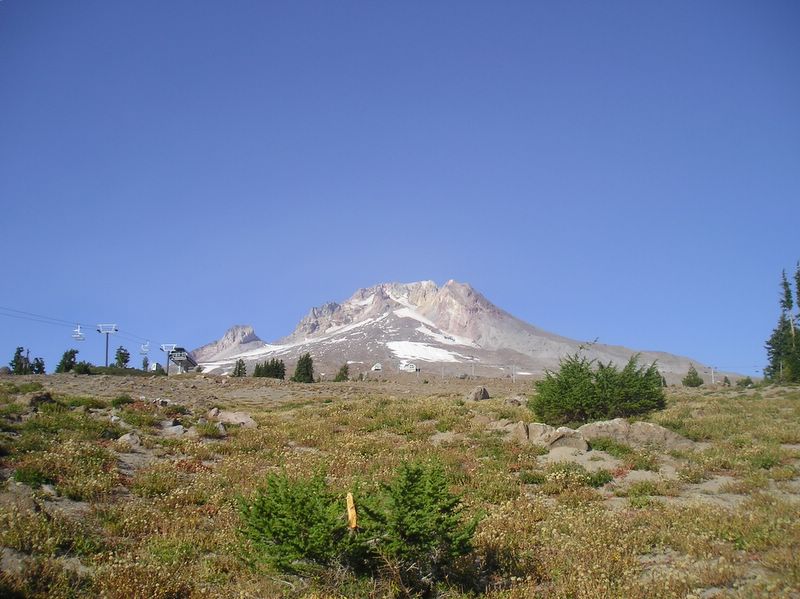
First some stats and history: Mount Hood is 11,237 feet tall (or 3,426 meters if you prefer). It is a stratovolcano -- that is, a volcano composed of explosively erupted cinders and ash with occasional lava flows. Mount Hood's main cone is about 500,000 years old. Regarding its volcanic history, it has had only four eruptive periods in the last 15,000 years. The most "recent" of those was 250-180 years ago. Though its eruptions have been few and far between, future volcanic activity is not outside the realm of possibility and would endanger the communities on its flank.

We began our hike at the Timberline Lodge, a National Historic Landmark completed in 1938 as a WPA project during the Depression. It is a magnificent structure which speaks to the rugged elegance of the high peaks of the western United States. Poke around the Timberline Lodge website and you will see exactly what I mean.

We began our day riding the ski lift which originates just east of the lodge. This lift, according to Alpenglow Ski History, was built in 1938 and was probably the second chairlift in America, following the one in Sun Valley which was built in 1936. The Mount Hood lift was named the Magic Mile because it originated above treeline and extended for nearly a mile. Fascinating details on its construction are described by Thomas P. Deering, Jr. in his 1986 Master's thesis entitled Mountain Architecture: An Alternative Design Proposal for the Wy'East Day Lodge, Mount Hood Oregon (Master of Architecture Thesis, University of Washington). The lift we took is actually the third incarnation of the Magic Mile chairlift. Like the original, it originates at 5,924 feet and took us up to the small buildings in the middle of the mountain slope, just beneath the glacier. (It's easier to see the buildings if you click on the picture to make it larger.) The elevation of those buildings is 7,015 feet.


At the higher elevation, the glaciers were accessible. My son hiked on the nearest glacier for a bit.


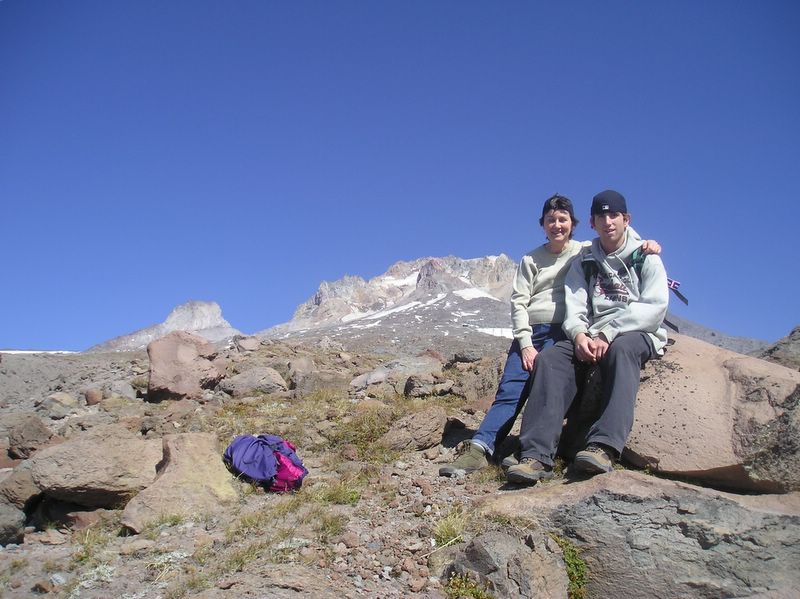
We all hiked upwards from the chairlift. Here is a picture of me and my son at about 7,600 feet with Mount Hood's peak still 4,000 feet above us.


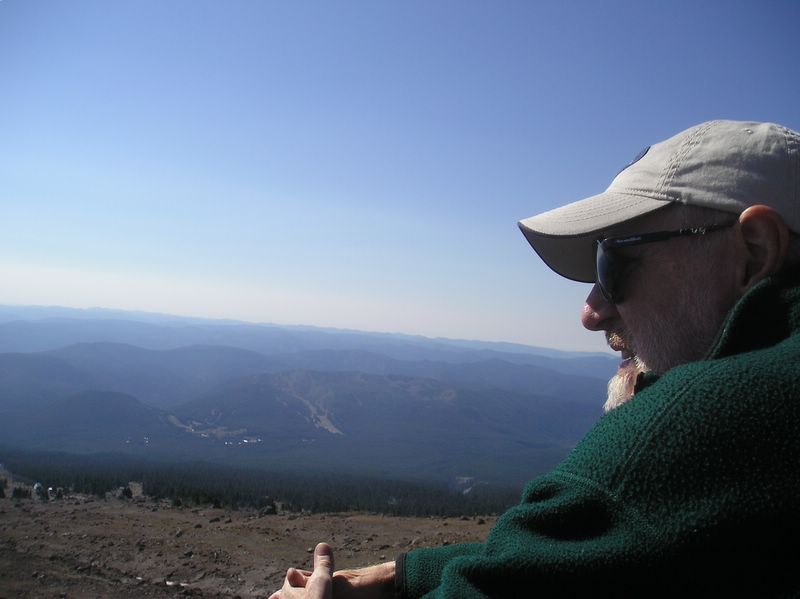
Here is my husband looking at the view from the chairlift.


At about 6000 feet, we hiked the Timberline Trail through wooded areas . . .


and through two glacial canyons - the Sand and the Little Zigzag. Here are my husband and son on their way out of Little Zigzag Canyon. The camera angle makes this canyon looks enormous, but keep in mind its name.


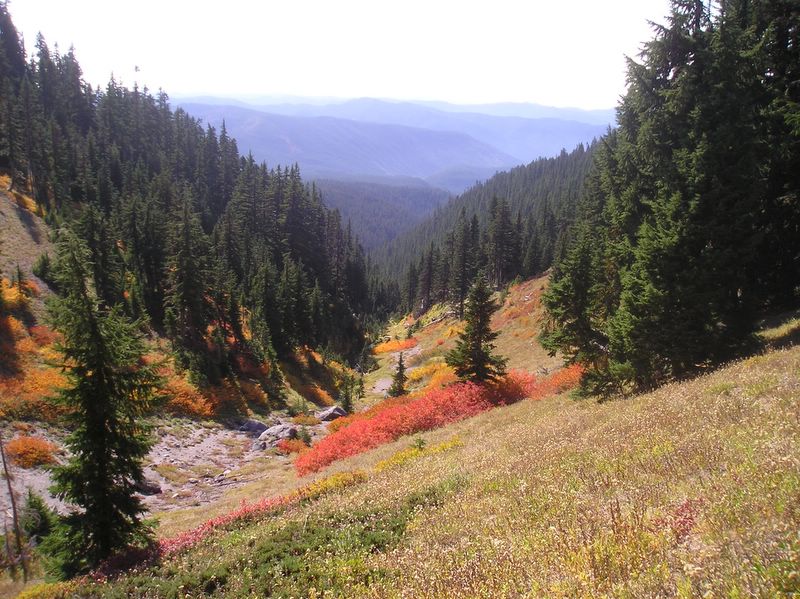
Next we went through an area where shrubs provided beautiful fall colors to contrast with the evergreens.


The enormous expanse of the (big) Zigzag Canyon with its 750 foot drop down to the Zigzag River was breathtaking. We lingered here for some time - soaking in the splendor, eating our apples and trail mix, and taking some pictures. Who could resist?


After the hike we returned tired and hungry to the Timberline Lodge and found ourselves some comfortable sofas with an exquisite mountain view in the Rams Head Bar. We ordered hearty sandwiches with mulled cider and Guinness and remained there gazing out at the snowy peak long after we finished our meal. My son drove us back to the motel where we all fell exhausted into bed, satisfied with our efforts and the time spent together.

(All the photos in this post are mine.)

© 2006, Linda Mason Hood
Truffles, Turtles & Tunes Copyright Statement