Showing posts with label travels. Show all posts
Sunday, June 05, 2011
In Pursuit of the Elusive Gopher Tortoise
(This post is a follow-up to my previous post dated May 18, 2011.)
Less than a week after learning gopher tortoises existed, I found myself in gopher tortoise territory. If there were enough gopher tortoises to warrant road signs, surely I could see one during our four-day visit to Sanibel Island to attend my cousin's wedding. I vowed to check out a few places where gopher tortoises might be seen in the free time between wedding events and family gatherings.
Friday, February 25, 2011
Three Days in the Olympic Peninsula
(Part I of a three-part series on my 2010 vacation in the Pacific Northwest)
I hate winter. One of my most effective coping devices involves either planning future vacations or reliving vacations I've taken in the past. In the spirit of getting through the winter, then, here's the first of a three-part series devoted to my excursion to the Pacific Northwest in September of 2010, when my husband and I toured through the Olympic Peninsula, Seattle, southern British Columbia, and the Mt. Baker wilderness.
Part I will confine itself to our three days in the Olympic Peninsula. Our route is depicted below. The various locations I describe will match the letters on the map.
View Larger Map
I hate winter. One of my most effective coping devices involves either planning future vacations or reliving vacations I've taken in the past. In the spirit of getting through the winter, then, here's the first of a three-part series devoted to my excursion to the Pacific Northwest in September of 2010, when my husband and I toured through the Olympic Peninsula, Seattle, southern British Columbia, and the Mt. Baker wilderness.
Part I will confine itself to our three days in the Olympic Peninsula. Our route is depicted below. The various locations I describe will match the letters on the map.
View Larger Map
Location:
Olympic Peninsula, West End, WA, USA
Sunday, August 29, 2010
Close Encounter with a Snapping Turtle
I had seen real, live snapping turtles before, in zoos or shelters, but not in the middle of a lonely country road. As snappers go, he wasn't even that big, but he was still an awesome sight. Here he is, just as I saw him from the car, happily basking in the late afternoon sun smack in the center of the road in Greene County, New York (which is in the Catskill Mountains).

Labels:
2010,
Catskills Irish Arts Week,
travels,
turtles
Location:
Round Top, NY, USA
Tuesday, August 10, 2010
Enameling with Catherine Crowe
Since this was my sixth time attending Catskills Irish Arts Week (CIAW), I decided to try my hand at one of the Celtic art classes: enameling. The class was taught by Catherine Crowe, who made the enamel crown on my new flute. I took a pretty consistent set of pictures during the work on my first piece. These pictures offer a glimpse at the process, starting with the copper strips above which will become earrings.
Labels:
2010,
Catskills Irish Arts Week,
travels
Location:
East Durham, Cairo, NY, USA
Saturday, June 12, 2010
Statue of Liberty and Ellis Island Tour Suggestions
(updated June 14, 2012)
The time it takes to see the Statue of Liberty can range from an hour to a whole day. I've divided up the options into various sightseeing scenarios. Times Square is the point of departure.
Scenario ONE - visit to Liberty Island and possibly Ellis Island as well: 4-7 hours total from Times Square and back.
Important note: The inside of the Statue of Liberty will be closed for renovation until approximately November 2012. You cannot climb up the Statue or visit the museum in the lobby. You may take the boat out to Liberty Island for close-up views of the Statue and incredible views of the Manhattan skyline. You will enjoy the lovely park around the Statue on Liberty Island. But that won't take too long. Therefore, your visit to Liberty Island would probably be less than an hour, making the total time for this trip more like 4 hours, depending on how long you spend in the museum at Ellis Island.
From Times Square, take the Downtown #1 subway to the South Ferry stop. (takes about 30 min) This lets you off on the WEST side of Battery Park. Walk into the park and follow the signs to Castle Clinton National Monument.
Statue of Liberty ferries depart from Battery Park and go first to Liberty Island and then to Ellis Island before returning to Battery Park. Tickets can be purchased online, a MUST during peak tourist seasons. (See the link in the next paragraph.) The ticket you purchase entitles you to visit both Liberty Island and Ellis Island. There is no cost for the museums on those islands, but I think there is an additional fee to go to the top of the Statue of Liberty. Audio headsets for self-guided tours cost extra also.
Going out the the Statue, looking around, and returning is normally about a 3-hour venture. (Allow only an hour between November 2011-November 2012 while renovations have closed the inside of the Statue to visitors.) Here's the website with info about the Statue of Liberty National Monument, including online ticket purchase. Be sure to note the bit about climbing stairs. Also, please understand that I consider the time estimates on the Statue of Liberty National Monument website to be grossly underestimated. My estimates here are based on actual visits and on the assumption that you READ as you peruse the museums!
There is another little island out in the New York Harbor called Ellis Island. In the early days when people were coming to the United States in droves, they were sent first to Ellis Island where government officials "processed" them before letting them into the country. Often they were detained for quite a long time. Ellis Island was eventually closed down and lay dormant out there in the harbor for 30 years. In 1990 a museum was established, and the island came alive again with fascinating immigrant stories. Some Americans are able to see histories and items belonging to family members. The exhibit is really timeless, though, as people emigrate from one place to another today for all sorts of reasons, and many of their struggles are the same. The Ellis Island museum is both a particular history as well as an account of a more universal experience. If this sort of thing interests you, I highly recommend going on to Ellis Island as well.
Scenario TWO - view of the Statue of Liberty from the Staten Island Ferry: 2 hours total, from Times Square and back.
If you're pressed for time and all you want is a really nice view of the Statue of Liberty, take the Staten Island Ferry from the tip of Manhattan over to Staten Island, then turn around and come back. The Staten Island Ferry is free and the views of the Statue as well as the Manhattan skyline are terrific!
From Times Square, take the Downtown N, R, or W subway to the Whitehall Street stop. (takes about 30 min.) Walk to the Staten Island Ferry Terminal. You'll see it when you come up from the subway.
The Staten Island Ferry website has not only the ferry schedules but cool info about the boats and their history.
photo by William Warby
(permission for use under the Creative Commons Attribution 2.0 Generic licence)
The time it takes to see the Statue of Liberty can range from an hour to a whole day. I've divided up the options into various sightseeing scenarios. Times Square is the point of departure.
Scenario ONE - visit to Liberty Island and possibly Ellis Island as well: 4-7 hours total from Times Square and back.
Important note: The inside of the Statue of Liberty will be closed for renovation until approximately November 2012. You cannot climb up the Statue or visit the museum in the lobby. You may take the boat out to Liberty Island for close-up views of the Statue and incredible views of the Manhattan skyline. You will enjoy the lovely park around the Statue on Liberty Island. But that won't take too long. Therefore, your visit to Liberty Island would probably be less than an hour, making the total time for this trip more like 4 hours, depending on how long you spend in the museum at Ellis Island.
From Times Square, take the Downtown #1 subway to the South Ferry stop. (takes about 30 min) This lets you off on the WEST side of Battery Park. Walk into the park and follow the signs to Castle Clinton National Monument.
Statue of Liberty ferries depart from Battery Park and go first to Liberty Island and then to Ellis Island before returning to Battery Park. Tickets can be purchased online, a MUST during peak tourist seasons. (See the link in the next paragraph.) The ticket you purchase entitles you to visit both Liberty Island and Ellis Island. There is no cost for the museums on those islands, but I think there is an additional fee to go to the top of the Statue of Liberty. Audio headsets for self-guided tours cost extra also.
Going out the the Statue, looking around, and returning is normally about a 3-hour venture. (Allow only an hour between November 2011-November 2012 while renovations have closed the inside of the Statue to visitors.) Here's the website with info about the Statue of Liberty National Monument, including online ticket purchase. Be sure to note the bit about climbing stairs. Also, please understand that I consider the time estimates on the Statue of Liberty National Monument website to be grossly underestimated. My estimates here are based on actual visits and on the assumption that you READ as you peruse the museums!
There is another little island out in the New York Harbor called Ellis Island. In the early days when people were coming to the United States in droves, they were sent first to Ellis Island where government officials "processed" them before letting them into the country. Often they were detained for quite a long time. Ellis Island was eventually closed down and lay dormant out there in the harbor for 30 years. In 1990 a museum was established, and the island came alive again with fascinating immigrant stories. Some Americans are able to see histories and items belonging to family members. The exhibit is really timeless, though, as people emigrate from one place to another today for all sorts of reasons, and many of their struggles are the same. The Ellis Island museum is both a particular history as well as an account of a more universal experience. If this sort of thing interests you, I highly recommend going on to Ellis Island as well.
photo by Ken Thomas
(public domain photo, no permission required)
If you're pressed for time and all you want is a really nice view of the Statue of Liberty, take the Staten Island Ferry from the tip of Manhattan over to Staten Island, then turn around and come back. The Staten Island Ferry is free and the views of the Statue as well as the Manhattan skyline are terrific!
From Times Square, take the Downtown N, R, or W subway to the Whitehall Street stop. (takes about 30 min.) Walk to the Staten Island Ferry Terminal. You'll see it when you come up from the subway.
The Staten Island Ferry website has not only the ferry schedules but cool info about the boats and their history.
Scenario THREE - view of the Statue of Liberty from the Staten Island Ferry, combined with other sightseeing in the nearby Financial District. All the places noted below are in walking distance of each other. Depending on how many stops you make, the time can vary from 2 hours to an entire day.
If you're starting at the Staten Island Ferry Terminal, you see these things in this order. First the ferry ride to see the Statue as described in Scenario Two, then:
If you spend the whole day on Scenario One at Liberty & Ellis Islands, but still want to see the places listed in Scenario Three, you can return the next day and do just the Financial District attractions.
These are some of my favorite sites in New York. Hope you enjoy them too!
If you're starting at the Staten Island Ferry Terminal, you see these things in this order. First the ferry ride to see the Statue as described in Scenario Two, then:
- First stop is the Fraunces Tavern, located on Pearl Street very near the Staten Island Ferry. It is a small building with a museum containing many interesting Revolutionary War relics, also a comfortable pub and an upscale restaurant. George Washington said goodbye to his officers here at the end of the Revolutionary War.
- Walk north on Water Street, turn right at Fulton Street and roam through the South Street Seaport. The Seaport contains a maritime museum as well as many shops and restaurants.
- Walk south to Wall Street. Strolling west on Wall Street, you will see the famous view always shown on TV news programs.
- At Wall and Broad Streets you will see Federal Hall where our first president, George Washington, took his oath of office.
- At Wall and Broad Streets, facing west and looking to your left down Broad Street, you will see the New York Stock Exchange.
- On the far west end of Wall Street is Trinity Church (at Wall Street and Broadway) - a beautiful historic church with a cemetery next door. Go inside, look around, have a seat, rest your feet and meditate.
- Walking North on Broadway just a few blocks will bring you to St. Paul Chapel at Broadway and Fulton Street. St. Paul's is another historic church in an entirely different architectural style from Trinity. St. Paul's contains many memoirs of the World Trade Center disaster, as this was church was a base station all through the recovery efforts. (On the website, look for Ground Zero Ministry)
- In back of St. Paul Chapel is the World Trade Center site. The construction of new buildings on the site is still in progress, but memorial is now open. I haven't been there yet, but friends tell me it is beautiful and very well done.
- Behind the World Trade Center site is The World Financial Center. Go inside and enjoy a cup of coffee in the huge atrium - maybe a concert too if you're lucky!
- As you exit the Atrium towards the river, you'll see a beautiful yacht marina on the Hudson River.
- Walk south through Battery Park City, a new apartment and business complex with lovely walkways and parks and a GREAT view of the Hudson River. Looking south, you can see the Statue of Liberty in the distance!
If you spend the whole day on Scenario One at Liberty & Ellis Islands, but still want to see the places listed in Scenario Three, you can return the next day and do just the Financial District attractions.
These are some of my favorite sites in New York. Hope you enjoy them too!
Monday, July 13, 2009
Pianos, Jewels, and Inns of Court - Monday
Maurene and I saw a handful of things on Monday that didn't easily fit into Breakfast Rambles or Sacred Spaces, the previous two posts devoted to our day of sightseeing on July 13, 2009. This post, then, completes the Monday trilogy.
Several times throughout the day we saw oddly painted pianos sitting on the sidewalk or in public atriums. This one, in Liverpool Street Station, was the only one we saw being played.
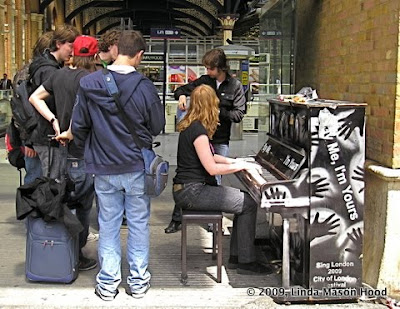
Later I learned that these pianos were part of an urban art project entitled Play Me, I'm Yours. This project by Luke Jerram placed 30 pianos in heavily populated public places. The intention was to create personal amusement or perhaps spontaneous street theater as people sat down to play the pianos. The exhibit lasted three weeks, then the pianos were given to schools and community groups.
After lunch at Ye Olde Mitre Tavern (see my Sacred Spaces post) Maurene and I did a bit of window shopping in the Hatten Garden jewelry district, an area bounded by Holborn, Gray's Inn Road, Clerkenwell Road, and Farringdon Road. Click here for a map. The jewelry was dazzling, shop after shop. Best to leave quickly and avoid temptation!
Next we looked at the half-timbered Tudor buildings on High Holborn. Very pretty buildings, and very old -- they date back to 1586.


The half-timbered buildings form the northern side of the Staple Inn. Behind them, lovely red brick buildings surround a peaceful landscaped interior garden.


Staple Inn is the last surviving Inn of Chancery. The Inns of Chancery, dating back to 1344, originally served as offices for clerks of chancery (a type of law). Later, the inns provided not only office space but also living quarters for the chancery lawyers who were called solicitors. Until 1642 the Inns of Chancery also provided initial training for barristers. It's interesting to note that solicitors practiced a different type of law than barristers, but today's lawyers in Britain are qualified to practice in both areas of law.
The Inns of Chancery were initially attached to the early Inns of Court. Inns of Court were voluntary associations originating in the Middle Ages. According to Encyclopedia Britannica they were formed to study English law as opposed to Roman law that was taught in the universities. There were four Inns of Court: Inner Temple, Middle Temple, Gray's Inn, and Lincoln's Inn.
I found the term "inn" puzzling. Of course, I hadn't yet read all the explanatory material above, so my frame of reference was that of temporary lodging for travelers. Maurene explained that the inns we had seen were law offices, and sometimes lawyers even maintained a small apartment there. Still, the architecture and grounds of these inns were as elaborate as cathedrals and seemed a bit much, even for a high profession like the law. A fuller explanation was to be found -- where else? -- in Wikipedia. Quoting from the article on the Inns of Court. "Each inn is a substantial complex with a great hall, chapel, libraries, sets of chambers for many hundreds of barristers, and gardens, and covers several acres. The layout is similar to that of an "Oxbridge" college. The "chambers" were originally used as residences as well as business premises by many of the barristers, but today, with a small number of exceptions, they serve as offices only."
This explanation was well illustrated by Lincoln's Inn, a much bigger property than the Staple Inn. Built in the mid-1800's, the buildings had a grander scale but the same austere air of seriousness. I was amused to learn that the building I thought was a chapel is actually the library. Makes sense, right? The law library is after all the most sacred of the buildings in a legal complex.
The shot below illustrates a bit better than my photos just how much this building resembles a cathedral.
In between the Staple Inn and the Lincoln's Inn we visited The London Silver Vaults. Originally opened in 1876 as Chancery Lane Safe Deposit, these vaults were available for rental by wealthy Londoners who wanted to protect their valuables. Upon showing ID and checking our bags, Maurene and I went downstairs where we passed through a huge fortified safe door with a very imposing lock. Inside, we wandered the many hallways lined with rooms. Each room, a vault within a vault, was the shop of an antique silver dealer. The Silver Vaults contain silver from a variety of different cultures and historical periods -- cutlery & table service, tea sets (of course), jewelry & watches, lamps, and decorative pieces of all sorts including animals & birds, large and small. I thought I might buy a small turtle, and we did actually find one but it wasn't small enough to be affordable.
Back at Maurene's flat we needed tea and a nap to regain enough strength to go to dinner. We still can't believe how much ground we covered. It's a wonder we made it to dinner at all, really, but hunger drove us out the door. We ended up at a restaurant called Il Bordello, where very good Italian food was served in huge portions. And so, tired and stuffed with pasta, Maurene and I concluded what will probably be a "personal best" for both of us in the category of jam-packed London sightseeing days!
Several times throughout the day we saw oddly painted pianos sitting on the sidewalk or in public atriums. This one, in Liverpool Street Station, was the only one we saw being played.
Later I learned that these pianos were part of an urban art project entitled Play Me, I'm Yours. This project by Luke Jerram placed 30 pianos in heavily populated public places. The intention was to create personal amusement or perhaps spontaneous street theater as people sat down to play the pianos. The exhibit lasted three weeks, then the pianos were given to schools and community groups.
After lunch at Ye Olde Mitre Tavern (see my Sacred Spaces post) Maurene and I did a bit of window shopping in the Hatten Garden jewelry district, an area bounded by Holborn, Gray's Inn Road, Clerkenwell Road, and Farringdon Road. Click here for a map. The jewelry was dazzling, shop after shop. Best to leave quickly and avoid temptation!
Next we looked at the half-timbered Tudor buildings on High Holborn. Very pretty buildings, and very old -- they date back to 1586.
The half-timbered buildings form the northern side of the Staple Inn. Behind them, lovely red brick buildings surround a peaceful landscaped interior garden.
Staple Inn is the last surviving Inn of Chancery. The Inns of Chancery, dating back to 1344, originally served as offices for clerks of chancery (a type of law). Later, the inns provided not only office space but also living quarters for the chancery lawyers who were called solicitors. Until 1642 the Inns of Chancery also provided initial training for barristers. It's interesting to note that solicitors practiced a different type of law than barristers, but today's lawyers in Britain are qualified to practice in both areas of law.
The Inns of Chancery were initially attached to the early Inns of Court. Inns of Court were voluntary associations originating in the Middle Ages. According to Encyclopedia Britannica they were formed to study English law as opposed to Roman law that was taught in the universities. There were four Inns of Court: Inner Temple, Middle Temple, Gray's Inn, and Lincoln's Inn.
I found the term "inn" puzzling. Of course, I hadn't yet read all the explanatory material above, so my frame of reference was that of temporary lodging for travelers. Maurene explained that the inns we had seen were law offices, and sometimes lawyers even maintained a small apartment there. Still, the architecture and grounds of these inns were as elaborate as cathedrals and seemed a bit much, even for a high profession like the law. A fuller explanation was to be found -- where else? -- in Wikipedia. Quoting from the article on the Inns of Court. "Each inn is a substantial complex with a great hall, chapel, libraries, sets of chambers for many hundreds of barristers, and gardens, and covers several acres. The layout is similar to that of an "Oxbridge" college. The "chambers" were originally used as residences as well as business premises by many of the barristers, but today, with a small number of exceptions, they serve as offices only."
This explanation was well illustrated by Lincoln's Inn, a much bigger property than the Staple Inn. Built in the mid-1800's, the buildings had a grander scale but the same austere air of seriousness. I was amused to learn that the building I thought was a chapel is actually the library. Makes sense, right? The law library is after all the most sacred of the buildings in a legal complex.
The shot below illustrates a bit better than my photos just how much this building resembles a cathedral.
In between the Staple Inn and the Lincoln's Inn we visited The London Silver Vaults. Originally opened in 1876 as Chancery Lane Safe Deposit, these vaults were available for rental by wealthy Londoners who wanted to protect their valuables. Upon showing ID and checking our bags, Maurene and I went downstairs where we passed through a huge fortified safe door with a very imposing lock. Inside, we wandered the many hallways lined with rooms. Each room, a vault within a vault, was the shop of an antique silver dealer. The Silver Vaults contain silver from a variety of different cultures and historical periods -- cutlery & table service, tea sets (of course), jewelry & watches, lamps, and decorative pieces of all sorts including animals & birds, large and small. I thought I might buy a small turtle, and we did actually find one but it wasn't small enough to be affordable.
Back at Maurene's flat we needed tea and a nap to regain enough strength to go to dinner. We still can't believe how much ground we covered. It's a wonder we made it to dinner at all, really, but hunger drove us out the door. We ended up at a restaurant called Il Bordello, where very good Italian food was served in huge portions. And so, tired and stuffed with pasta, Maurene and I concluded what will probably be a "personal best" for both of us in the category of jam-packed London sightseeing days!
© 2009, Linda Mason Hood
Truffles, Turtles & Tunes Copyright Statement
Sacred Spaces - Monday
After breakfast at the Barbican (see Breakfast Rambles - Monday), Maurene and I set off on foot to see some sacred spaces.
Our first stop was St. Helen's, an Anglican church in the Bishopsgate area. Actually, St. Helen's wasn't on Maurene's itinerary. We stumbled upon it rather by accident, and I insisted we take a quick look. We were glad we did, for the building has an interesting construction which reflects its long history.
St. Helen's worship space was originally two separate chapels. Apparently there was a parish church that predated the chapel built in 1210 for an order of Benedictine nuns. The nuns' chapel was a little wider and longer than the parish church, giving the present sanctuary an odd shape.
St. Helen's has many claims to fame: It is the only surviving monastic building inside the city walls. It survived the Great Fire, the World War II Blitz, and two IRA bombings in the 1990s. It was the parish church of William Shakespeare in 1590. It may have the longest name of any single church. It's full and proper name, which includes the names of all 5 parishes consolidated from the 16th century to the present, is: "St Helen Bishopsgate with St Andrew Undershaft & St Ethelburga Bishopsgate & St Martin Outwich & St Mary Axe".
(For each slideshow in this post, you can make the pictures larger by double click the first one. Then, on the Picasa Web site, click on Slideshow.)
Additional info on St. Helen's:
1) St. Helen's Bishopsgate - historical timeline on the church's website
2) St. Helen's Bishopsgate, Tour UK website - more historical details
3) St. Helen's Bishopsgate, Wikipedia - most representative pictures and good references in the footnotes.
On our way to the next place of worship, Maurene and I walked through the Leadenhall Market. The narrow street leading into the covered market reminded me that I was in a very old part of the city. The market itself was established in the fourteenth century, but it stands on a site which dates back to AD 47 when the Roman city of Londinium was built.
More recently, the market was used to depict Diagon Alley in the movie Harry Potter and the Philosopher's Stone. Harry Potter fans, do you recognize this ornate ironwork?

Additional info on the Leadenhall Market:
1) Leadenhall Market - historical timeline
2) Leadenhall Market, Wikipedia - short synopsis, wonderful picture
After a few wrong turns which resulted in crisscrossing the Leadenhall Market, we finally arrived at the Bevis Marks Synagogue. Its website explained why we had trouble finding it: The synagogue was actually built in a back alley because in 1699 Jews weren't allowed to put their buildings on the main roadways. Bevis Marks, completed in 1701, is the oldest synagogue in continuous use in London. The website link above is really interesting and quite well done. I highly recommend it to you for all the background details that I'm about to skip. I will just touch upon the aspects of the synagogue that I particularly enjoyed.
Upon entering the building, I immediately noticed a similarity to Quaker (Nonconformist) meetinghouses: balconies that circle above the main meeting space on three sides, and large windows with many panes of clear glass to let in the light. Later I learned that the builder of the synagogue was a Quaker named. No wonder there was a similarity! This Quaker, Joseph Avis, built the synagogue at cost because he felt it unethical to make a profit from the construction of a house of worship.
Perhaps the lavish decoration of the synagogue reflects the tastes of the original congregation, which was comprised of Sephardic Jews from Spain and Portugal. I particularly liked the brass chandeliers which filled the room, seven of them representing the seven days of the week. The chandeliers still had candles in them, which looked well used. There were also large brass candlesticks by the pulpit and the cabinet containing the Ark of the Covenant. While there were some electric lights in the balcony and on the tops of the pillars supporting the balcony, it seemed like the main source of light in the evening would probably come from candles. It was a very elegant and beautifully maintained sanctuary.
Here are a few pictures - they aren't great, so be sure you look at the the ones on the main Bevis Marks website as well.
Additional info on Bevis Marks:
1) Bevis Marks, Jewish Communities & Records (JCR) UK website - congregation data, other information which includes detailed Congregation History, good bibliography.
2) Bevis Marks, Wikipedia, good description, nice links.
3) Bevis Marks, Sacred Destinations website, concise summary and a map showing exact location
Our next stop was St. Ethelreda's, a Roman Catholic church in Ely Place. St. Ethelreda's was built between 1250 and 1290. Over time, the chapel and the crypt below served different purposes. In the mid-1500, the crypt was used as a tavern. From 1620 to 1622 the chapel served as Spanish ambassador's private chapel (and thus it was considered on "Spanish soil"). In 1642 during the English Civil War it was used as a prison and hospital. It was closed for a while, then reopened as an Episcopalian church before it was put up for auction in 1873 and bought by a Catholic priest who restored both the chapel and the crypt to their 13th century design. The crypt was used as a tavern in the 16th century. All said, this building indeed has a long and interesting history.
Despite the fact that it was not very well lit, Maurene and I especially enjoyed the crypt. It was obviously very old and gave us the sense of stepping back in time.
In the upper church, Maurene and I strolled the side aisles looking at the statues of martyrs from various historical periods, people from the area who probably attended this church. We took a moment to rest in the pews and commune with the spirit of St. Ethelreda. And she was actually there. I don't know if we realized it at the time, but on the right of the altar is a jeweled box said to contain a piece of St. Ethelreda's hand.
Additional info on St. Ethelreda's Church
1) St. Ethelreda's Church, Wikipedia, good summary and nice pictures
2) St. Ethelreda's History, part of St. Ethelreda's website - most complete historical information.
3) St. Ethelreda's Gallery, part of St. Ethelreda's website - pictures of all stained glass windows in the church and the crypt.
4) The Hand of St. Ethelreda by Dwight Longenecker, Fr. Dwight Longenecker's website - essay which suggests the hand of St. Ethelreda is symbolic of the Catholic Church in England
Our first stop was St. Helen's, an Anglican church in the Bishopsgate area. Actually, St. Helen's wasn't on Maurene's itinerary. We stumbled upon it rather by accident, and I insisted we take a quick look. We were glad we did, for the building has an interesting construction which reflects its long history.
St. Helen's worship space was originally two separate chapels. Apparently there was a parish church that predated the chapel built in 1210 for an order of Benedictine nuns. The nuns' chapel was a little wider and longer than the parish church, giving the present sanctuary an odd shape.
St. Helen's has many claims to fame: It is the only surviving monastic building inside the city walls. It survived the Great Fire, the World War II Blitz, and two IRA bombings in the 1990s. It was the parish church of William Shakespeare in 1590. It may have the longest name of any single church. It's full and proper name, which includes the names of all 5 parishes consolidated from the 16th century to the present, is: "St Helen Bishopsgate with St Andrew Undershaft & St Ethelburga Bishopsgate & St Martin Outwich & St Mary Axe".
(For each slideshow in this post, you can make the pictures larger by double click the first one. Then, on the Picasa Web site, click on Slideshow.)
Additional info on St. Helen's:
1) St. Helen's Bishopsgate - historical timeline on the church's website
2) St. Helen's Bishopsgate, Tour UK website - more historical details
3) St. Helen's Bishopsgate, Wikipedia - most representative pictures and good references in the footnotes.
More recently, the market was used to depict Diagon Alley in the movie Harry Potter and the Philosopher's Stone. Harry Potter fans, do you recognize this ornate ironwork?
Additional info on the Leadenhall Market:
1) Leadenhall Market - historical timeline
2) Leadenhall Market, Wikipedia - short synopsis, wonderful picture
After a few wrong turns which resulted in crisscrossing the Leadenhall Market, we finally arrived at the Bevis Marks Synagogue. Its website explained why we had trouble finding it: The synagogue was actually built in a back alley because in 1699 Jews weren't allowed to put their buildings on the main roadways. Bevis Marks, completed in 1701, is the oldest synagogue in continuous use in London. The website link above is really interesting and quite well done. I highly recommend it to you for all the background details that I'm about to skip. I will just touch upon the aspects of the synagogue that I particularly enjoyed.
Upon entering the building, I immediately noticed a similarity to Quaker (Nonconformist) meetinghouses: balconies that circle above the main meeting space on three sides, and large windows with many panes of clear glass to let in the light. Later I learned that the builder of the synagogue was a Quaker named. No wonder there was a similarity! This Quaker, Joseph Avis, built the synagogue at cost because he felt it unethical to make a profit from the construction of a house of worship.
Perhaps the lavish decoration of the synagogue reflects the tastes of the original congregation, which was comprised of Sephardic Jews from Spain and Portugal. I particularly liked the brass chandeliers which filled the room, seven of them representing the seven days of the week. The chandeliers still had candles in them, which looked well used. There were also large brass candlesticks by the pulpit and the cabinet containing the Ark of the Covenant. While there were some electric lights in the balcony and on the tops of the pillars supporting the balcony, it seemed like the main source of light in the evening would probably come from candles. It was a very elegant and beautifully maintained sanctuary.
Here are a few pictures - they aren't great, so be sure you look at the the ones on the main Bevis Marks website as well.
Additional info on Bevis Marks:
1) Bevis Marks, Jewish Communities & Records (JCR) UK website - congregation data, other information which includes detailed Congregation History, good bibliography.
2) Bevis Marks, Wikipedia, good description, nice links.
3) Bevis Marks, Sacred Destinations website, concise summary and a map showing exact location
Our next stop was St. Ethelreda's, a Roman Catholic church in Ely Place. St. Ethelreda's was built between 1250 and 1290. Over time, the chapel and the crypt below served different purposes. In the mid-1500, the crypt was used as a tavern. From 1620 to 1622 the chapel served as Spanish ambassador's private chapel (and thus it was considered on "Spanish soil"). In 1642 during the English Civil War it was used as a prison and hospital. It was closed for a while, then reopened as an Episcopalian church before it was put up for auction in 1873 and bought by a Catholic priest who restored both the chapel and the crypt to their 13th century design. The crypt was used as a tavern in the 16th century. All said, this building indeed has a long and interesting history.
Despite the fact that it was not very well lit, Maurene and I especially enjoyed the crypt. It was obviously very old and gave us the sense of stepping back in time.
In the upper church, Maurene and I strolled the side aisles looking at the statues of martyrs from various historical periods, people from the area who probably attended this church. We took a moment to rest in the pews and commune with the spirit of St. Ethelreda. And she was actually there. I don't know if we realized it at the time, but on the right of the altar is a jeweled box said to contain a piece of St. Ethelreda's hand.
Additional info on St. Ethelreda's Church
1) St. Ethelreda's Church, Wikipedia, good summary and nice pictures
2) St. Ethelreda's History, part of St. Ethelreda's website - most complete historical information.
3) St. Ethelreda's Gallery, part of St. Ethelreda's website - pictures of all stained glass windows in the church and the crypt.
4) The Hand of St. Ethelreda by Dwight Longenecker, Fr. Dwight Longenecker's website - essay which suggests the hand of St. Ethelreda is symbolic of the Catholic Church in England
The final sacred space of this post is Ye Olde Mitre Tavern. In 1546 when it was built, the Mitre was a pub for the palace servants of the Bishops of Ely - the same Bishops who worshiped at St. Ethelreda's Church. Like the church, the Mitre went through a restoration about 200 years ago. In addition to being named for a bishop's cap, I'm classifying Ye Olde Mitre as a sacred space because it has has always been a place where people could meet together to escape from their mundane lives for a little while and return revived and refreshed. Think of it as a non-denominational, non-theological church of the common man -- or woman, as the case may be.
By the time Maurene and I arrived at the Mitre, we were certainly ready to rest our weary feet and have lunch. We ordered a grilled cheese sandwich and a glass of hard cider. Then we took a look around. All the rooms are small, but there are two sitting rooms downstairs separated by the bar in between them. Both rooms are lined in dark paneling and with their low ceilings impart the feel of a much earlier time. Up a narrow, winding staircase is the Bishop's Room, now just another room for patrons to socialize, as well as the ladies room and the office.
Interestingly, the bit of land on which the Mitre stands is still under the governance of Cambridgeshire, not London. This dates back to the 13th century and its connection to the Ely Palace. For some reason, this bit of land was never incorporated into the City of London. According to TimeOut London, if robbers from the nearby jewelry district run down the alley that leads to the Mitre, the only thing London police can do is seal off the exits and call their counterparts from Cambridgeshire to come make the arrest!
Additional info:
Secret London: Ye Olde Mitre Tavern, Timeout London. Good historical details.
© 2009, Linda Mason Hood
Truffles, Turtles & Tunes Copyright Statement
Breakfast Rambles - Monday
Today was my first full day in London after a week in Ireland at the Willie Clancy Festival in Miltown Malbay. (All of those posts are accessible by clicking the Topic Label "Willie Week 2009" in the blue box on the left.) My friend Maurene had an ambitious sightseeing itinerary planned. Much of what we were to see on my 3-day visit fell under the category of "old." For example, yesterday we went to The Oriental Club and Rules, both dating back to the early 1800s. The first items on today's agenda, however, were more recent additions to the historic city of London.
After a cup of tea and a shower, Maurene and I were out and about by 9 AM. Our first stop was an office/apartment complex called Cutler Gardens at 3-11 Devonshire Square. Despite its picturesque name, the original buildings that comprised Cutler Gardens were warehouses belonging to the East India Company, later used by the St. Katherine's Dock Company and the Port of London Authority. From 1978-1982 the warehouses were remodeled for use by the Standard Life Assurance Company. In 1990, a sculpture by Denys Mitchell was installed in the courtyard. The Cnihtengild, a bronze and glass sculpture of a knight on horseback, has a modern style which nevertheless succeeds in invoking all the drama and force of the days of King Arthur. The plaque below the sculpture reads as follows:
“King Edgar (959–75) granted this derelict land to thirteen knights, on condition that they each perform three duels, one on land, one below ground, one on the water. These feats having been achieved, the King gave the knights, or Cnihtengild, certain rights over a piece of land ‘from Aldgate to the place where the bars are now, toward the east, on both sides of the lane, and extended it toward the gate now known as Bishopsgate in the north, to the house of William the Priest… and to the south to the Thames as far as a horseman riding into the river at low tide can throw a lance.’
“This sculpture by Denys Mitchell, commissioned by the Standard Life Assurance Company, commemorates the Cnihtengild and was unveiled by the Right Honourable the Lord Mayor, Sir Alexander Graham G.B.E. D.C.L. on 21st November 1990.”
And here's a fact about The Cnihtengild that so far has escaped mention on the internet: the statue MOVES. The position of the horse's head, the rider's head, and the rider's lance change on the hour.
Moving on, our next stop was the entrance to the Liverpool Street Station of the London Underground to see another sculpture, the Kindertransport Memorial, by Frank Meisler, completed in 2006. The sculpture depicts Jewish refugee children rescued from the Nazis. The UK admitted about 10,000 children between December 1938 and August 1939. Sent unaccompanied and placed in foster homes, most of these children never saw their families again. The Liverpool Street Station was chosen as the site for the sculpture because it is where the children disembarked from the Harwich boat train.
A quote at the base of the statue says:
"Whosoever rescues a single soul is credited as though they had saved the whole world." (Talmud, Baba Batra 11a.)
Our breakfast destination was The Barbican Estate where Maurene's friend Val lives. Before the Barbican was built, hardly anyone lived in that part of the city because it had been destroyed by heavy bombing in World War II. The Barbican, which opened in 1969, brought 4000 residents and many other people who come to attend events in the Barbican Centre, the largest performing arts center in Europe.
The Barbican complex is architecturally significant. Built by Chamberlin, Powell and Bon, one of the most important modernist architectural firms in Britain, The Barbican is an example of the Brutalist style. The entire complex is elevated from street level, and the landscaped grounds are quiet and beautiful. Once inside, you lose the bustle of London and enter a quieter world of nature and art. There are three large towers and 13 terraced 7-story buildings. Val's living room offers a lovely view of the large reflecting pool called "the lake" in which grow water lilies and other types of vegetation.
Val served us a breakfast of freshly baked croissants and berries with coffee, tea, and juice. She was a gracious hostess, and it would have been easy to linger for hours chatting and taking pictures. However, our sightseeing agenda beckoned, so before too long Maurene and I bid a fond farewell to the Val and the Barbican.
After a cup of tea and a shower, Maurene and I were out and about by 9 AM. Our first stop was an office/apartment complex called Cutler Gardens at 3-11 Devonshire Square. Despite its picturesque name, the original buildings that comprised Cutler Gardens were warehouses belonging to the East India Company, later used by the St. Katherine's Dock Company and the Port of London Authority. From 1978-1982 the warehouses were remodeled for use by the Standard Life Assurance Company. In 1990, a sculpture by Denys Mitchell was installed in the courtyard. The Cnihtengild, a bronze and glass sculpture of a knight on horseback, has a modern style which nevertheless succeeds in invoking all the drama and force of the days of King Arthur. The plaque below the sculpture reads as follows:
“King Edgar (959–75) granted this derelict land to thirteen knights, on condition that they each perform three duels, one on land, one below ground, one on the water. These feats having been achieved, the King gave the knights, or Cnihtengild, certain rights over a piece of land ‘from Aldgate to the place where the bars are now, toward the east, on both sides of the lane, and extended it toward the gate now known as Bishopsgate in the north, to the house of William the Priest… and to the south to the Thames as far as a horseman riding into the river at low tide can throw a lance.’
“This sculpture by Denys Mitchell, commissioned by the Standard Life Assurance Company, commemorates the Cnihtengild and was unveiled by the Right Honourable the Lord Mayor, Sir Alexander Graham G.B.E. D.C.L. on 21st November 1990.”
And here's a fact about The Cnihtengild that so far has escaped mention on the internet: the statue MOVES. The position of the horse's head, the rider's head, and the rider's lance change on the hour.
(To make the pictures larger, double click the first one.
Then, on the Picasa Web site, click on Slideshow.)
Moving on, our next stop was the entrance to the Liverpool Street Station of the London Underground to see another sculpture, the Kindertransport Memorial, by Frank Meisler, completed in 2006. The sculpture depicts Jewish refugee children rescued from the Nazis. The UK admitted about 10,000 children between December 1938 and August 1939. Sent unaccompanied and placed in foster homes, most of these children never saw their families again. The Liverpool Street Station was chosen as the site for the sculpture because it is where the children disembarked from the Harwich boat train.
"Whosoever rescues a single soul is credited as though they had saved the whole world." (Talmud, Baba Batra 11a.)
Our breakfast destination was The Barbican Estate where Maurene's friend Val lives. Before the Barbican was built, hardly anyone lived in that part of the city because it had been destroyed by heavy bombing in World War II. The Barbican, which opened in 1969, brought 4000 residents and many other people who come to attend events in the Barbican Centre, the largest performing arts center in Europe.
The Barbican complex is architecturally significant. Built by Chamberlin, Powell and Bon, one of the most important modernist architectural firms in Britain, The Barbican is an example of the Brutalist style. The entire complex is elevated from street level, and the landscaped grounds are quiet and beautiful. Once inside, you lose the bustle of London and enter a quieter world of nature and art. There are three large towers and 13 terraced 7-story buildings. Val's living room offers a lovely view of the large reflecting pool called "the lake" in which grow water lilies and other types of vegetation.
(To make the pictures larger, double click the first one.
Then, on the Picasa Web site, click on Slideshow.)
Val served us a breakfast of freshly baked croissants and berries with coffee, tea, and juice. She was a gracious hostess, and it would have been easy to linger for hours chatting and taking pictures. However, our sightseeing agenda beckoned, so before too long Maurene and I bid a fond farewell to the Val and the Barbican.
© 2009, Linda Mason Hood
Truffles, Turtles & Tunes Copyright Statement
Sunday, July 12, 2009
From Miltown Malbay to London - Sunday
Like clockwork, my cab arrived at 6 AM to take me to Ennis where I would catch the 7:05 bus to the Shannon Airport. I was very thankful to be able to split the 45 Euro cab ride with a young Hungarian woman also needing to arrive early at the bus station. We arrived in Ennis with time to spare. The bus station was closed, so we chatted on the porch to keep out of the cold wind and rain. At 7:05 AM there was no bus in sight. Around 7:08, a bus pulled into one of the empty loading lanes. I squinted to read the destination, having difficulty because of the rain. Before I could make out the words, I saw the bus back up and pull out of the loading lane and drive away! The bus stopped only long enough for that driver to shift into reverse gear. I was furious, but no amount of indignation was going to bring the bus back.
By this time a few cabs had arrived. Since there were no more airport buses until afternoon, I had no choice but to hire a second cab. I managed to get the fare down to about 30 Euros, I think. It turned out to be a really expensive morning, despite sharing the first cab. All together I spent about 55 Euros getting to the Shannon Airport. (For US readers, 1 Euro = about 1.40 US Dollars)
At the Shannon Airport I had my first Ryanair experience. Ryanair is an airline that makes short hops all over Europe, popular for business and weekend travel. They keep the fares low by charging extra fees for a long list of things. Their weight limit for checked baggage is 15 kilograms; 10 kilograms for the one carry-on bag you are allowed (your purse must be stuffed inside your one carry-on). Well, if you recall, I had purchased a heavy hardback flute reference book. I was also packing a jar of orange marmalade, a gift for my husband. My checked bag was about 6 kilograms overweight. At 15 Euros per kilogram, the overweight luggage fee would be the equivalent of another expensive cab ride. Not good! I stepped to the side and repacked, shoving as much in my carry-on as possible. During the frantic repacking, I got the bright idea to store things in the many pockets of my rain jacket. Brilliant, as nobody was going to weigh my coat. I was able to keep my carry-on bag under the limit (just barely) and reduce the weight of my checked bag to 16 kilograms. I paid the much reduced overweight fee, and with a self-satisfied chuckle I was on my way. It wasn't until I went through security that I realized that the marmalade was one of the items in my rain jacket. Airport security wouldn't let me keep it, so with regret I watched them pitch my Irish Whiskey Orange Marmalade into the trash bin.
My friend Maurene met me at Stansted Airport in London with her friend Tom and his cab. Tom drove us back to Maurene's apartment where we took a little nap before dinner.
Refreshed, we were off to meet another of Maurene's many friends, Alec, at the club where he stays when he comes into London for a visit. The Oriental Club is in fact a very old and historic institution. Quoting the website, it is "... a Private Gentlemen's Club founded in 1824 by and for the benefit of members of or retired from the East India Company." Though its present quarters have been modernized, the aura is definitely stately and aristocratic with majestic decor, lovely antiques, and a variety of relics that recall the bygone days of Britain's Indian empire. Alec gave us a tour before we moved on to dinner.
Next stop: Rules, the oldest restaurant in London -- 200 years in operation. Rules specializes in traditional English food such as "classic game cookery, oysters, pies, and puddings." The dishes which feature game are said to be especially good, since the animals come from an estate owned by the family who owns the restaurant. Rules had rich mahogany interiors and lots of stained glass, but what impressed me most (aside from the food) was the waitstaff. In the cocktail lounge as well as in the dining room, they were pleasant and welcoming, knowledgeable about the food, and they knew how to appear only when we actually needed something rather than constantly interrupting us to ask if everything was ok. The food and drinks were delicious. Our conversation was interesting and entertaining. All in all, it was a delightful evening. Dinner at Rules provided a marvelous beginning for my London adventure.
Alec, Maurene and I with our Pimm's
By this time a few cabs had arrived. Since there were no more airport buses until afternoon, I had no choice but to hire a second cab. I managed to get the fare down to about 30 Euros, I think. It turned out to be a really expensive morning, despite sharing the first cab. All together I spent about 55 Euros getting to the Shannon Airport. (For US readers, 1 Euro = about 1.40 US Dollars)
At the Shannon Airport I had my first Ryanair experience. Ryanair is an airline that makes short hops all over Europe, popular for business and weekend travel. They keep the fares low by charging extra fees for a long list of things. Their weight limit for checked baggage is 15 kilograms; 10 kilograms for the one carry-on bag you are allowed (your purse must be stuffed inside your one carry-on). Well, if you recall, I had purchased a heavy hardback flute reference book. I was also packing a jar of orange marmalade, a gift for my husband. My checked bag was about 6 kilograms overweight. At 15 Euros per kilogram, the overweight luggage fee would be the equivalent of another expensive cab ride. Not good! I stepped to the side and repacked, shoving as much in my carry-on as possible. During the frantic repacking, I got the bright idea to store things in the many pockets of my rain jacket. Brilliant, as nobody was going to weigh my coat. I was able to keep my carry-on bag under the limit (just barely) and reduce the weight of my checked bag to 16 kilograms. I paid the much reduced overweight fee, and with a self-satisfied chuckle I was on my way. It wasn't until I went through security that I realized that the marmalade was one of the items in my rain jacket. Airport security wouldn't let me keep it, so with regret I watched them pitch my Irish Whiskey Orange Marmalade into the trash bin.
My friend Maurene met me at Stansted Airport in London with her friend Tom and his cab. Tom drove us back to Maurene's apartment where we took a little nap before dinner.
Refreshed, we were off to meet another of Maurene's many friends, Alec, at the club where he stays when he comes into London for a visit. The Oriental Club is in fact a very old and historic institution. Quoting the website, it is "... a Private Gentlemen's Club founded in 1824 by and for the benefit of members of or retired from the East India Company." Though its present quarters have been modernized, the aura is definitely stately and aristocratic with majestic decor, lovely antiques, and a variety of relics that recall the bygone days of Britain's Indian empire. Alec gave us a tour before we moved on to dinner.
© 2009, Linda Mason Hood
Truffles, Turtles & Tunes Copyright Statement
Saturday, July 11, 2009
Willie Week - Saturday
Today is the last day of Willie Week. Gail and Dan, who had come from Dublin for just one night (see Friday's post), left immediately after breakfast. I headed off in the opposite direction to attend the final flute class. It has been a good week. I have 30 new tunes to work on and some new techniques to incorporate into my playing. In the final class, Conal and Tara played through most of the tunes we learned for the benefit of someone whose recorder broke, but it was a good way to review all the tunes. There was ample time for Q&A about all sorts of things -- how to practice more efficiently, how to get a stronger sound, the most important elements of traditional Irish flute playing, etc. Overall, this class is probably the single most helpful set of lessons I've ever had in Irish traditional flute playing. Here is a picture to commemorate a terrific flute class.
After purchasing a few gifts for my family at a local antique store, I went to the ad hoc Willie Week store which had been set up in the Community Center. All the teachers brought CDs to sell; there was also a good collection of CDs and books as well as Willie Week T-shirts and book bags. I bought 4 CDs and 2 books. One of the books deserves special mention: The Irish Flute Player's Handbook, a Comprehensive Guide to the Traditional Flute in Ireland by S.C. "Hammy" Hamilton. This book is THE definitive reference book for the Irish flute. At the time I bought this heavy hard cover edition, I considered it a "must have" despite its weight. Writing this blog post, I discovered the book is currently out of print, as it was part of a limited edition. And mine is a signed copy too! Apparently another printing is planned, so if you're interested, contact Hammy Hamilton using the instructions on his website. (see the link above)
After dropping off my purchases at the B&B, I set out to find Willie Clancy's grave. Last Sunday the festival opened with a memorial at the grave site. Since I wasn't able to attend, I wanted to make my own pilgrimage to visit the man whose playing inspired this festival. The Ballard graveyard was about one mile out of town, on the same road as the library. It was a nice uphill walk with views of the countryside sloping down to the Atlantic Ocean that just got better and better as I got farther out of town.
Just before reaching the cemetery, I met an elderly man carrying a small plastic bag. He was very old - in his 80's perhaps - and very poor. His back was hunched under his threadbare coat spotted with dust. He was wearing a tweed cap. I asked him if I was going the right direction. I could barely understand his answer -- he had a very thick accent and no teeth. Yes, he said, I would see the graveyard soon, just at the top of the hill and to the right. With pride beaming from watery old eyes that peered out from under the peculiar clumps of wiry gray eyebrow hair, he asked -- word for word -- the same question that all the townspeople had been asking me all week: "Are ye enjoyin' the festival?" Everyone took such pride in the fact that people came from far and wide to Miltown Malbay to celebrate the musical tradition that produced Willie Clancy. Coming from this fellow, however, the earnestness of his question made it more poignant. Aware of the difference in our accents as well as our economic status, I graciously assured him that indeed I was enjoying the festival and that I had had a marvelous week. Proud and satisfied, he repeated the directions to the cemetery. I thanked him again. As we parted ways, he turned down a footpath and headed across a field, presumably to his home although there were no buildings were anywhere to be seen. Despite his pronounced poverty, here was a man who knew how rich was the region's musical heritage. Though our conversation had been brief, we had made a strong connection based on mutual appreciation of the music.
The cemetery was a mixture of old graves and new, with the majority of markers erected in the twentieth century. The tombs from the nineteenth century were especially fascinating. Willie Clancy was buried in a family plot, but there was a special memorial plaque adjacent to the family plot. I took lots of pictures of the panoramic views as well as the graves.
My evening's activity was the 3-hour recital in the Community Center. The hall was packed, and there were many wonderful performances by instructors and others from the region. The audience seemed to consist of townspeople as well as festival visitors. The final musical offering was led by the local choirmaster; the singers were adults as well as children from the town - another illustration of the fact that music is an integral part of the life of the town.
After the recital I picked up fish and curry chips one last time from the chipper (see Thursday's post), and headed back to the B&B to pack. Tomorrow starts a new adventure!
After purchasing a few gifts for my family at a local antique store, I went to the ad hoc Willie Week store which had been set up in the Community Center. All the teachers brought CDs to sell; there was also a good collection of CDs and books as well as Willie Week T-shirts and book bags. I bought 4 CDs and 2 books. One of the books deserves special mention: The Irish Flute Player's Handbook, a Comprehensive Guide to the Traditional Flute in Ireland by S.C. "Hammy" Hamilton. This book is THE definitive reference book for the Irish flute. At the time I bought this heavy hard cover edition, I considered it a "must have" despite its weight. Writing this blog post, I discovered the book is currently out of print, as it was part of a limited edition. And mine is a signed copy too! Apparently another printing is planned, so if you're interested, contact Hammy Hamilton using the instructions on his website. (see the link above)
After dropping off my purchases at the B&B, I set out to find Willie Clancy's grave. Last Sunday the festival opened with a memorial at the grave site. Since I wasn't able to attend, I wanted to make my own pilgrimage to visit the man whose playing inspired this festival. The Ballard graveyard was about one mile out of town, on the same road as the library. It was a nice uphill walk with views of the countryside sloping down to the Atlantic Ocean that just got better and better as I got farther out of town.
Just before reaching the cemetery, I met an elderly man carrying a small plastic bag. He was very old - in his 80's perhaps - and very poor. His back was hunched under his threadbare coat spotted with dust. He was wearing a tweed cap. I asked him if I was going the right direction. I could barely understand his answer -- he had a very thick accent and no teeth. Yes, he said, I would see the graveyard soon, just at the top of the hill and to the right. With pride beaming from watery old eyes that peered out from under the peculiar clumps of wiry gray eyebrow hair, he asked -- word for word -- the same question that all the townspeople had been asking me all week: "Are ye enjoyin' the festival?" Everyone took such pride in the fact that people came from far and wide to Miltown Malbay to celebrate the musical tradition that produced Willie Clancy. Coming from this fellow, however, the earnestness of his question made it more poignant. Aware of the difference in our accents as well as our economic status, I graciously assured him that indeed I was enjoying the festival and that I had had a marvelous week. Proud and satisfied, he repeated the directions to the cemetery. I thanked him again. As we parted ways, he turned down a footpath and headed across a field, presumably to his home although there were no buildings were anywhere to be seen. Despite his pronounced poverty, here was a man who knew how rich was the region's musical heritage. Though our conversation had been brief, we had made a strong connection based on mutual appreciation of the music.
The cemetery was a mixture of old graves and new, with the majority of markers erected in the twentieth century. The tombs from the nineteenth century were especially fascinating. Willie Clancy was buried in a family plot, but there was a special memorial plaque adjacent to the family plot. I took lots of pictures of the panoramic views as well as the graves.
(To make the pictures larger, double click the first one.
Then, on the Picasa Web site, click on Slideshow.)
My evening's activity was the 3-hour recital in the Community Center. The hall was packed, and there were many wonderful performances by instructors and others from the region. The audience seemed to consist of townspeople as well as festival visitors. The final musical offering was led by the local choirmaster; the singers were adults as well as children from the town - another illustration of the fact that music is an integral part of the life of the town.
After the recital I picked up fish and curry chips one last time from the chipper (see Thursday's post), and headed back to the B&B to pack. Tomorrow starts a new adventure!
© 2009, Linda Mason Hood
Truffles, Turtles & Tunes Copyright Statement
Friday, July 10, 2009
Willie Week - Friday
This morning it was raining pretty hard, so Lauren drove the car down to the flute class. As you recall, today we were all to play separately and receive individual comments from Conal and Tara, our teachers. Everyone was nervous; some were more prepared than others. Sometimes the comments focused on breathing; we were advised to leave out rolls (an ornament similar to a turn in classical nomenclature) or even melody notes to create enough time to take a breath. Other comments emphasized rhythm or pace. We were cautioned never to play faster than we are able. Speed will come. Playing slower will allow us to get the half-beat in the right place, essential for crisp rhythm. I was advised to keep a firmer hold on the flute and press it more solidly into my lip, also to blow at a deeper angle down into the flute's embouchure hole.
Among today's tunes were a Highland Fling and a Barndance. To give the tunes context, Tara had invited two dancers to demonstrate the Scottish Highland dance for us. I recorded a short video with my camera - forgive the quality, it's not a video camera. Using iMovie for the first time, I managed to add the recording I made of Tara playing the dance tune. The sound and the picture are not in sync though. I'm afraid that's beyond my iMovie capabilities at the moment!
After showing us the steps, the girls invited some of us to learn the dances. I let myself be persuaded, and I did pretty well if I do say so myself! Unfortunately I didn't appoint anyone to take a picture of me dancing, so you'll just have to take my word for it.
After the flute class I attended the lunchtime piping recital. The piping tradition is very strong in Miltown Malbay, as you would expect from the place that produced Willie Clancy. The Summer School offers a variety of courses for uilleann (pronounced IL-ee-an) pipers. Besides learning tunes and techniques, pipers learn how to make parts and do repairs. They also had listening classes and gave daily recitals. I have never heard so many excellent pipers in my life. The uilleann pipes are cranky, difficult instruments, but when played well they can be amazingly expressive and moving, probably as close to the human voice as an instrument can get.
Back at the library, I managed to accomplish my online Ryanair check-in and print the boarding pass. That was a relief.
Next I went to a beautiful song recital entitled Traditional Singing in Irish and English. Each singer was better than the one that came before. Very enjoyable, and very intimidating on a personal level. During Willie Week I came to the full realization that if I am ever to play the Irish flute really well, I had better focus just on flute. There are only so many hours in the day...
My roommates Lauren and Danika left in the afternoon to go back to Dublin, but Gail and Dan Neely, friends from the Washington Square Harp and Shamrock Orchestra, took their place. Gail and Dan were in Ireland for 6 weeks while Gail participated in a summer session abroad. They spent 3 weeks in Belfast and had just begun a 3-week stay in Dublin. We met around 8 pm, and after they brought their things into the B&B, we went out to find some music. We sampled the music and atmosphere in various pubs up and down the main street in town. We even walked down to the dance pavilion in the drizzling rain to check out the scene there and look for Lisa, another WSHSO friend who is here this week. She was nowhere to be seen. We found out later she was dancing in Spanish Point, a town nearby that also hosted dancing every night. We didn't play in any of the sessions - it was just too crowded and wet to lug the instruments around. (Dan's banjo is a lot bigger than the flutes Gail and I play.) We had a great time, and I was really glad they could make the 4-hour drive from Dublin to hang out with me for one night and get the flavor of Willie Week.
Among today's tunes were a Highland Fling and a Barndance. To give the tunes context, Tara had invited two dancers to demonstrate the Scottish Highland dance for us. I recorded a short video with my camera - forgive the quality, it's not a video camera. Using iMovie for the first time, I managed to add the recording I made of Tara playing the dance tune. The sound and the picture are not in sync though. I'm afraid that's beyond my iMovie capabilities at the moment!
After showing us the steps, the girls invited some of us to learn the dances. I let myself be persuaded, and I did pretty well if I do say so myself! Unfortunately I didn't appoint anyone to take a picture of me dancing, so you'll just have to take my word for it.
After the flute class I attended the lunchtime piping recital. The piping tradition is very strong in Miltown Malbay, as you would expect from the place that produced Willie Clancy. The Summer School offers a variety of courses for uilleann (pronounced IL-ee-an) pipers. Besides learning tunes and techniques, pipers learn how to make parts and do repairs. They also had listening classes and gave daily recitals. I have never heard so many excellent pipers in my life. The uilleann pipes are cranky, difficult instruments, but when played well they can be amazingly expressive and moving, probably as close to the human voice as an instrument can get.
Back at the library, I managed to accomplish my online Ryanair check-in and print the boarding pass. That was a relief.
Next I went to a beautiful song recital entitled Traditional Singing in Irish and English. Each singer was better than the one that came before. Very enjoyable, and very intimidating on a personal level. During Willie Week I came to the full realization that if I am ever to play the Irish flute really well, I had better focus just on flute. There are only so many hours in the day...
My roommates Lauren and Danika left in the afternoon to go back to Dublin, but Gail and Dan Neely, friends from the Washington Square Harp and Shamrock Orchestra, took their place. Gail and Dan were in Ireland for 6 weeks while Gail participated in a summer session abroad. They spent 3 weeks in Belfast and had just begun a 3-week stay in Dublin. We met around 8 pm, and after they brought their things into the B&B, we went out to find some music. We sampled the music and atmosphere in various pubs up and down the main street in town. We even walked down to the dance pavilion in the drizzling rain to check out the scene there and look for Lisa, another WSHSO friend who is here this week. She was nowhere to be seen. We found out later she was dancing in Spanish Point, a town nearby that also hosted dancing every night. We didn't play in any of the sessions - it was just too crowded and wet to lug the instruments around. (Dan's banjo is a lot bigger than the flutes Gail and I play.) We had a great time, and I was really glad they could make the 4-hour drive from Dublin to hang out with me for one night and get the flavor of Willie Week.
Dan wrote a blog post about their trip to Miltown Malbay. His post contains 39 pictures and a couple of recordings made during sessions we visited. Since my pictures from that night are not very good, I raise my glass to him and invite you to check out his account of their trip to Miltown Malbay and our romp in the rain that night.


© 2009, Linda Mason Hood
Truffles, Turtles & Tunes Copyright Statement
Thursday, July 09, 2009
Willie Week - Thursday
Another tune-packed day in the flute class. With 6 more tunes learned today, our total is now up to 18. Along with learning tunes, we are also learning some principles of technique. Today Conal and Tara talked about breathing -- where to take breaths and how often. Both our teachers advise against letting one's air reserve get more than half depleted. Their advice was to breathe quickly and often so as to never need a long time to take a breath. Tomorrow we will go around the class, each of us playing either The Rookery or Peach Blossom (tunes we learned yesterday), and Conal and Tara will offer individual advice on breathing and other aspects of our playing.
After class I made my daily dash to the library for my 30-minutes of internet. As I mentioned on Monday, there is precious little internet access in Miltown Malbay. The ONLY way to get online is by using one of the four library computers. You sign up when you arrive, wait your turn, and when your name is called you get exactly 30 minutes. If that's not enough, you're welcome to come back the next day. (Just make sure you know the hours the library is open, because they are different every day.) Since uploading pictures was both forbidden and blocked, I gave up my real-time blogging effort early on - thus these back-dated posts. Today's challenge was to do the online check-in for my Ryanair flight to London on Sunday morning. I hadn't realized I needed my passport in order to complete the check-in, so I will have to try again tomorrow.
After my trip to the library, I met Lauren who had found a nice session in the yard behind Cleary's pub. I joined her for a few tunes before a meal of fish and chips at "the chipper," a take-away place in the middle of town where you can get burgers as well as fish, and of course chips (or french fries as we Americans would call them). The chips could be ordered plain or with several toppings -- salt & vinegar, curry sauce, or garlic sauce. The curry sauce had only a hint of curry, but I liked the flavor and the curry chips quickly became my favorite. Everything was served in brown paper bags with a plastic dish in the bottom to catch the sauce. ( Again, no picture. What was I thinking!) We ate our food from the chipper outside the B&B so our room wouldn't smell like grease. The outdoors B&B cat, who had been rather stand-offish until now, suddenly got very friendly after we fed him bits of fish.

After dinner, Lauren drove me to see the Cliffs of Moher. We saw the Cliffs at dusk which was around 9 pm. The sun sets very late at this time of year in Ireland, between 10:30 and 11 pm. The views were breath-taking. Since we can see the Cliffs from our B&B, it was especially thrilling to experience them close up. I was really thankful Lauren felt like taking this little side trip.
After our drive to the Cliffs, Lauren joined Danika at the ceili and I went off to find myself a session. I ended up in the back room of the Central Hotel. Nearly all the people in the circle of players had white hair. The exceptions were Dennis Cahill on guitar and Brid O'Donaghue on flute. Many of those playing were teachers, others had obviously been playing all their lives, so the level of playing was very high. Even so, the tempos were relaxed and players savored the tunes. There were many songs mixed in with the tunes. Len Graham was in the room, but he didn't sing. Eventually a chair opened up and I joined in the playing. Between tunes I chatted with the man next to me who comes over from from the Achill Islands (pronounced AY-kull) every year for the festival. He had a flute from 1830 with very interesting keywork. I was pleased that the group played a few tunes that my teacher Mike Rafferty taught me a few weeks ago, as well as a waltz I learned just recently for the WSHSO - Dermot Grogan's Favorite. This night was very special, the highlight of my session playing experiences in Ireland. All by myself, I found really good playing and was able to participate.
When the session broke up around 1 AM, I decided to go home. Any session which would follow this one would surely be a disappointment. I was really happy and satisfied as I walked back to the B&B, alone under the stars on a country road in Ireland, with beautiful traditional music played much like it was hundreds of years ago still ringing in my ears.
After class I made my daily dash to the library for my 30-minutes of internet. As I mentioned on Monday, there is precious little internet access in Miltown Malbay. The ONLY way to get online is by using one of the four library computers. You sign up when you arrive, wait your turn, and when your name is called you get exactly 30 minutes. If that's not enough, you're welcome to come back the next day. (Just make sure you know the hours the library is open, because they are different every day.) Since uploading pictures was both forbidden and blocked, I gave up my real-time blogging effort early on - thus these back-dated posts. Today's challenge was to do the online check-in for my Ryanair flight to London on Sunday morning. I hadn't realized I needed my passport in order to complete the check-in, so I will have to try again tomorrow.
After my trip to the library, I met Lauren who had found a nice session in the yard behind Cleary's pub. I joined her for a few tunes before a meal of fish and chips at "the chipper," a take-away place in the middle of town where you can get burgers as well as fish, and of course chips (or french fries as we Americans would call them). The chips could be ordered plain or with several toppings -- salt & vinegar, curry sauce, or garlic sauce. The curry sauce had only a hint of curry, but I liked the flavor and the curry chips quickly became my favorite. Everything was served in brown paper bags with a plastic dish in the bottom to catch the sauce. ( Again, no picture. What was I thinking!) We ate our food from the chipper outside the B&B so our room wouldn't smell like grease. The outdoors B&B cat, who had been rather stand-offish until now, suddenly got very friendly after we fed him bits of fish.

After dinner, Lauren drove me to see the Cliffs of Moher. We saw the Cliffs at dusk which was around 9 pm. The sun sets very late at this time of year in Ireland, between 10:30 and 11 pm. The views were breath-taking. Since we can see the Cliffs from our B&B, it was especially thrilling to experience them close up. I was really thankful Lauren felt like taking this little side trip.
(To make the pictures larger, double click the first one.
Then, on the Picasa Web site, click on Slideshow.)
After our drive to the Cliffs, Lauren joined Danika at the ceili and I went off to find myself a session. I ended up in the back room of the Central Hotel. Nearly all the people in the circle of players had white hair. The exceptions were Dennis Cahill on guitar and Brid O'Donaghue on flute. Many of those playing were teachers, others had obviously been playing all their lives, so the level of playing was very high. Even so, the tempos were relaxed and players savored the tunes. There were many songs mixed in with the tunes. Len Graham was in the room, but he didn't sing. Eventually a chair opened up and I joined in the playing. Between tunes I chatted with the man next to me who comes over from from the Achill Islands (pronounced AY-kull) every year for the festival. He had a flute from 1830 with very interesting keywork. I was pleased that the group played a few tunes that my teacher Mike Rafferty taught me a few weeks ago, as well as a waltz I learned just recently for the WSHSO - Dermot Grogan's Favorite. This night was very special, the highlight of my session playing experiences in Ireland. All by myself, I found really good playing and was able to participate.
When the session broke up around 1 AM, I decided to go home. Any session which would follow this one would surely be a disappointment. I was really happy and satisfied as I walked back to the B&B, alone under the stars on a country road in Ireland, with beautiful traditional music played much like it was hundreds of years ago still ringing in my ears.
© 2009, Linda Mason Hood
Truffles, Turtles & Tunes Copyright Statement
Wednesday, July 08, 2009
Willie Week - Wednesday
We learned five more tunes in Day 3 of the flute class, bringing the total number of tunes taught to 12. In addition, there were two more tunes which were given out. Let me explain what I mean by tunes taught and tunes given out.
Tunes TAUGHT: As you may already know, tunes are taught aurally. The instructor plays the tune through a few times to introduce it to us, and we all record it on our tape or digital recorders. (Some type of recorder is an absolute necessity.) Then he or she breaks the tune into phrases, playing each phrase slowly then pausing while the class plays back that phrase. The same phrase is repeated and played back in call-and-response fashion until the class is able to play the tune more or less in unison. The harder tunes might take 15 or 20 minutes to learn, whereas simpler tunes can be learned much more quickly. Conal O’Grada, one of our teachers, said he once taught a particularly easy tune in 3.5 minutes and challenged us to beat that record. I’m happy to report that our class set a new record – 3 minutes and 8 seconds.
If the tune is really unusual and people are having trouble, sometimes our teachers would write the notes on the blackboard. However, Irish musicians use ABC notation since many – maybe most – players do not read music at all. In ABC notation, you simply write the note name as opposed to drawing a note on a musical staff. There are various abbreviations to denote octaves, and some even use certain squiggles to denote ornamentation.
Tunes GIVEN OUT: This phrase means that the teacher played the tune for us to record and learn later on our own.
One of the tunes given out today was a slow aire. Conal challenged us to try to learn a slow aire by listening to a singer’s performance of it, since any instrumental slow aire would be modeled after singing technique. Vocal ornamentation is extremely subtle and very nuanced, so I would imagine learning an instrumental aire from the singing of that aire could be a really interesting approach.
After class I went to Friel’s pub. Tara Diamond, one of our flute teachers, was playing there with some of the other teachers. (Tara is the blond whose back is to the camera in the picture above. And if you look closely, you can see me in the mirror, taking the picture!) The music was lovely, so I turned on my new recorder. I propped it inside the front pocket of my bag, hanging by the mike on the edge of the pocket. I guess the weight of the recorder caused the microphone to detach and fall off. When I discovered what had happened, I searched the floor and asked other patrons if they had seen the little T-microphone. The bartender said he had actually seen it lying on the bar, but of course it was gone by then, never to be seen again. I was in a really foul mood until I realized it could be replaced for about $19.95. After that, I decided to put the whole incident behind me and use my backup recorder. Thank goodness I had the presence of mind to bring along my old one.
In the afternoon I attended a presentation by Len Graham on the Ulster song tradition. Afterwards Lauren, Danika and I had dinner at the Bakehouse Restaurant, probably the best food in Miltown Malbay.
After dinner we went back to the dance tent to hear the Kilfenora Ceila Band. Tim Collins, who was part of the Washington Square Harp and Shamrock Orchestra when he was the Fulbright scholar at NYU in 2007-08, is one of the leaders of the Kilfenora. Their sound in contrast with the Tulla was very interesting. The Kilfenora had a string bass as part of the ensemble, as well more accordion/concertina sound. The Kilfenora's tempos were much faster, but the music seemed overall much smoother. They were selling their new CD, made to commemorate their 100th year as a band, so of course I bought one.
At the end of the night, they played some music for sean nos dancing (pronounced SHAWN-nohz) -- solo dancing where the feet stay close to the floor (as opposed to the high kicks of step dancing) and dancers improvise the sequence of steps. One at a time, dancers came to the center and danced. The band played until the succession of dancers seemed concluded.
After another action packed day, Lauren, Danika and I returned to the B&B to catch a few winks. It seems like our standard Willie Week bedtime is about 1:30 AM.
Tunes TAUGHT: As you may already know, tunes are taught aurally. The instructor plays the tune through a few times to introduce it to us, and we all record it on our tape or digital recorders. (Some type of recorder is an absolute necessity.) Then he or she breaks the tune into phrases, playing each phrase slowly then pausing while the class plays back that phrase. The same phrase is repeated and played back in call-and-response fashion until the class is able to play the tune more or less in unison. The harder tunes might take 15 or 20 minutes to learn, whereas simpler tunes can be learned much more quickly. Conal O’Grada, one of our teachers, said he once taught a particularly easy tune in 3.5 minutes and challenged us to beat that record. I’m happy to report that our class set a new record – 3 minutes and 8 seconds.
If the tune is really unusual and people are having trouble, sometimes our teachers would write the notes on the blackboard. However, Irish musicians use ABC notation since many – maybe most – players do not read music at all. In ABC notation, you simply write the note name as opposed to drawing a note on a musical staff. There are various abbreviations to denote octaves, and some even use certain squiggles to denote ornamentation.
Tunes GIVEN OUT: This phrase means that the teacher played the tune for us to record and learn later on our own.
One of the tunes given out today was a slow aire. Conal challenged us to try to learn a slow aire by listening to a singer’s performance of it, since any instrumental slow aire would be modeled after singing technique. Vocal ornamentation is extremely subtle and very nuanced, so I would imagine learning an instrumental aire from the singing of that aire could be a really interesting approach.
After class I went to Friel’s pub. Tara Diamond, one of our flute teachers, was playing there with some of the other teachers. (Tara is the blond whose back is to the camera in the picture above. And if you look closely, you can see me in the mirror, taking the picture!) The music was lovely, so I turned on my new recorder. I propped it inside the front pocket of my bag, hanging by the mike on the edge of the pocket. I guess the weight of the recorder caused the microphone to detach and fall off. When I discovered what had happened, I searched the floor and asked other patrons if they had seen the little T-microphone. The bartender said he had actually seen it lying on the bar, but of course it was gone by then, never to be seen again. I was in a really foul mood until I realized it could be replaced for about $19.95. After that, I decided to put the whole incident behind me and use my backup recorder. Thank goodness I had the presence of mind to bring along my old one.
In the afternoon I attended a presentation by Len Graham on the Ulster song tradition. Afterwards Lauren, Danika and I had dinner at the Bakehouse Restaurant, probably the best food in Miltown Malbay.
After dinner we went back to the dance tent to hear the Kilfenora Ceila Band. Tim Collins, who was part of the Washington Square Harp and Shamrock Orchestra when he was the Fulbright scholar at NYU in 2007-08, is one of the leaders of the Kilfenora. Their sound in contrast with the Tulla was very interesting. The Kilfenora had a string bass as part of the ensemble, as well more accordion/concertina sound. The Kilfenora's tempos were much faster, but the music seemed overall much smoother. They were selling their new CD, made to commemorate their 100th year as a band, so of course I bought one.
At the end of the night, they played some music for sean nos dancing (pronounced SHAWN-nohz) -- solo dancing where the feet stay close to the floor (as opposed to the high kicks of step dancing) and dancers improvise the sequence of steps. One at a time, dancers came to the center and danced. The band played until the succession of dancers seemed concluded.
After another action packed day, Lauren, Danika and I returned to the B&B to catch a few winks. It seems like our standard Willie Week bedtime is about 1:30 AM.
© 2009, Linda Mason Hood
Truffles, Turtles & Tunes Copyright Statement
Tuesday, July 07, 2009
Willie Week - Tuesday
Mornings are tough. Jetlag is not completely gone, so getting out of bed is a challenge. Breakfast provides the immediate motivation. The tea here is strong and tasty. The B&B breakfast menu is the full Irish fry-up: fried egg, sausages, rashers (strips of thinly sliced fried ham), black and white puddings -- small, round shaped-meat patties that look like miniature cupcakes without icing -- accompanied by white toast with jam. My vegetarian version is eggs, tomatoes, and toast. There is also wonderful brown bread and soda bread as well as fresh fruit, yogurt, and an assortment of cereals.
We learned five tunes in Day 2 of the flute class. Several other tunes were given out but not taught. Lovely tunes, and excellent instruction. I am really enjoying this class.
The next notable event of the day was the Flute and Whistle Recital. All of the teachers performed. Several played together, bringing the total number of musical presentations down to 24. The recital was 2 hours long, a veritable tour de force with many regional and individual styles as well as great variety of tone. Among those who played were Mary Bergin, Conal O'Grada, Sean Ryan, Fintan Vallely, Mick Crehan, Brid O'Donoghue, Billy Clifford, Mick Hand, May Bonne, Roisin Nic Dhonncha, Louise Mulcahy, Tara Diamond, Eamonn Cotter, Mick O'Connor, Francis O'Connor, Marcus O'Murchu, Marion McCarthy, Eibhlin de Paor, Ciaran Somers, Adrian McCarron, Catherine McEvoy, Peter Phelan, Aiofe Granville, Siobhan Hogan, Francie Rasdale, Gavin Whelan, Peter Friehl, Phil Somers and John Wynn. All are well known in Ireland; only a few are well known in America. More's the pity!
After the recital I went with Lauren and Danika to the ceili (Irish word for set dance, pronounced KAY-lee) - not because I dance, but because I wanted to hear the famous Tulla Ceili Band. Together for more than 60 years, the band members have changed, of course, but they still play the style and repertoire made them famous. All of the players are excellent, but the most widely known player is fiddler Martin Hayes. He is quite a virtuoso and has a solo career in addition to being a band member. At the end of the evening he did a 20-minute solo spot, fiddle with piano backing. Everyone stopped dancing and gathered around the bandstand to listen. It was spectacular. He pulled out all the stops, and people clapped and roared. What a night! The Tulla definitely lived up to their reputation, and I thoroughly enjoyed hearing them play. Here's a video clip of the Tulla Ceili Band playing at last year's Willie Clancy Festival. It gives you a taste of their music as well as what ceili dancing looks like.
We learned five tunes in Day 2 of the flute class. Several other tunes were given out but not taught. Lovely tunes, and excellent instruction. I am really enjoying this class.
The next notable event of the day was the Flute and Whistle Recital. All of the teachers performed. Several played together, bringing the total number of musical presentations down to 24. The recital was 2 hours long, a veritable tour de force with many regional and individual styles as well as great variety of tone. Among those who played were Mary Bergin, Conal O'Grada, Sean Ryan, Fintan Vallely, Mick Crehan, Brid O'Donoghue, Billy Clifford, Mick Hand, May Bonne, Roisin Nic Dhonncha, Louise Mulcahy, Tara Diamond, Eamonn Cotter, Mick O'Connor, Francis O'Connor, Marcus O'Murchu, Marion McCarthy, Eibhlin de Paor, Ciaran Somers, Adrian McCarron, Catherine McEvoy, Peter Phelan, Aiofe Granville, Siobhan Hogan, Francie Rasdale, Gavin Whelan, Peter Friehl, Phil Somers and John Wynn. All are well known in Ireland; only a few are well known in America. More's the pity!
After the recital I went with Lauren and Danika to the ceili (Irish word for set dance, pronounced KAY-lee) - not because I dance, but because I wanted to hear the famous Tulla Ceili Band. Together for more than 60 years, the band members have changed, of course, but they still play the style and repertoire made them famous. All of the players are excellent, but the most widely known player is fiddler Martin Hayes. He is quite a virtuoso and has a solo career in addition to being a band member. At the end of the evening he did a 20-minute solo spot, fiddle with piano backing. Everyone stopped dancing and gathered around the bandstand to listen. It was spectacular. He pulled out all the stops, and people clapped and roared. What a night! The Tulla definitely lived up to their reputation, and I thoroughly enjoyed hearing them play. Here's a video clip of the Tulla Ceili Band playing at last year's Willie Clancy Festival. It gives you a taste of their music as well as what ceili dancing looks like.
© 2009, Linda Mason Hood
Truffles, Turtles & Tunes Copyright Statement
Monday, July 06, 2009
Willie Week - Monday
Today was my official first day of the Willie Clancy Summer School in Miltown Malbay, County Clare, Ireland. Jetlag notwithstanding, I made it to the flute class which started at 10 AM. Taught by Conal O'Grada and Tara (Bingham) Diamond, it was a fascinating class. Conal has a very colorful sense of humor, so he entertains while he instructs. Taras soft-spoken manner provides a complementary balance.
Each teacher taught us a tune. Then we broke for coffee/tea at the local pub, which served some tasty scones as well. Back in the class, we went around the room - all 18 students - playing the first tune. Each student received some feedback and helpful advice on how to improve his or her playing. I was neither the best nor the worst. Conal commented on the fact that I moved around too much, which would account for why the flute didn't seem securely planted on my chin. I learned that the strong woody sound Irish players get requires that the flute be pushed really firmly into your chin. Now mind you, I didn't realize I was moving, nor did I think the flute felt insecure, but when I adjusted my hand position as instructed and firmed up the pressure, I could hear the difference immediately! Something to work on, for sure.
After class I went on a quest for internet access. I walked the length of the town twice, only to confirm that on Monday there is no public internet access in Miltown Malbay because the library is closed. No internet cafes, no wireless in the B&B. Nothing. I guess this should not be a surprise. I am in rural Ireland, after all.
At 3 pm I attended a lecture by Tim Collins, a friend from the Washington Square Harp and Shamrock Orchestra. Tim was part of our group when he was the Fulbright scholar at NYU in 2007-08. His lecture was called Around the house and mind the bonfire - dance spaces in East Clare and South East Galway. It was very interesting with many old photographs and film clips, but I don't have enough knowledge of Irish set dancing to attempt a summary. Sorry...
At 5 pm I returned to the B&B to practice the tunes I learned this morning and experiment with some of the techniques I want to incorporate into my playing. After Lauren and Danika returned, we all headed out to the town of Lahinch for dinner. Lahinch is a resort town right on the ocean, home of one of Ireland's well known links golf courses. We drove on the coast road and the scenery was absolutely stunning.
We had a delicious meal at the Corner Stone Inn before returning to Miltown.

For the evening's amusement, Lauren and I dropped Danika off at the ceili (pronounced KAY-lee) and then continued on to a pub called Crosses of Annagh outside Miltown. We were both pretty tired, and the music was nothing special, so we came home early (midnight). All in all, a very satisfying day.
Each teacher taught us a tune. Then we broke for coffee/tea at the local pub, which served some tasty scones as well. Back in the class, we went around the room - all 18 students - playing the first tune. Each student received some feedback and helpful advice on how to improve his or her playing. I was neither the best nor the worst. Conal commented on the fact that I moved around too much, which would account for why the flute didn't seem securely planted on my chin. I learned that the strong woody sound Irish players get requires that the flute be pushed really firmly into your chin. Now mind you, I didn't realize I was moving, nor did I think the flute felt insecure, but when I adjusted my hand position as instructed and firmed up the pressure, I could hear the difference immediately! Something to work on, for sure.
After class I went on a quest for internet access. I walked the length of the town twice, only to confirm that on Monday there is no public internet access in Miltown Malbay because the library is closed. No internet cafes, no wireless in the B&B. Nothing. I guess this should not be a surprise. I am in rural Ireland, after all.
At 3 pm I attended a lecture by Tim Collins, a friend from the Washington Square Harp and Shamrock Orchestra. Tim was part of our group when he was the Fulbright scholar at NYU in 2007-08. His lecture was called Around the house and mind the bonfire - dance spaces in East Clare and South East Galway. It was very interesting with many old photographs and film clips, but I don't have enough knowledge of Irish set dancing to attempt a summary. Sorry...
At 5 pm I returned to the B&B to practice the tunes I learned this morning and experiment with some of the techniques I want to incorporate into my playing. After Lauren and Danika returned, we all headed out to the town of Lahinch for dinner. Lahinch is a resort town right on the ocean, home of one of Ireland's well known links golf courses. We drove on the coast road and the scenery was absolutely stunning.
We had a delicious meal at the Corner Stone Inn before returning to Miltown.

For the evening's amusement, Lauren and I dropped Danika off at the ceili (pronounced KAY-lee) and then continued on to a pub called Crosses of Annagh outside Miltown. We were both pretty tired, and the music was nothing special, so we came home early (midnight). All in all, a very satisfying day.
© 2009, Linda Mason Hood
Truffles, Turtles & Tunes Copyright Statement
Subscribe to:
Posts (Atom)


